
The future of AI is already in the classroom
The classroom has always adapted. Now it is adapting faster than ever.
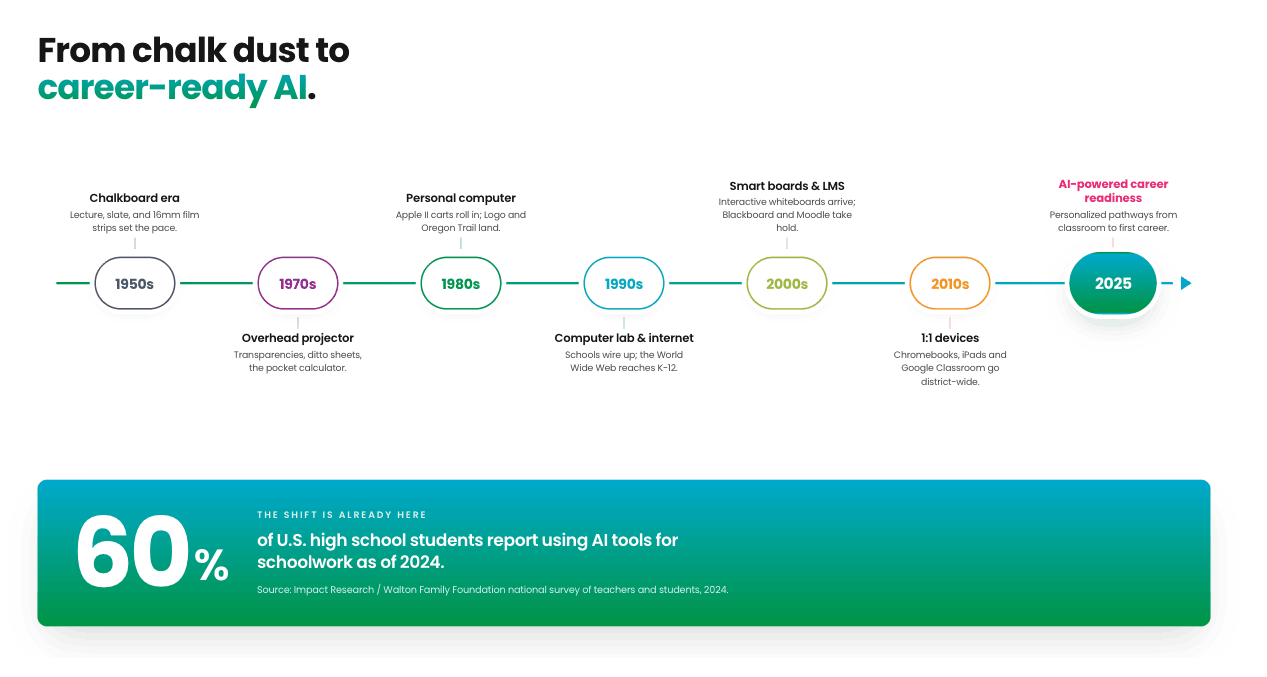
Every generation of educators has watched technology reshape what happens inside a school. The chalkboard gave way to the whiteboard. The card catalog gave way to the internet. And now, artificial intelligence is not just entering the classroom as a novelty tool. It is fundamentally changing how students learn, how educators teach, and, most significantly for those of us in career readiness, how young people begin to understand their own futures.
For high school students specifically, the implications are enormous. AI is no longer something students will encounter when they enter the workforce. It is already shaping how they study, how they search for information, how they draft written work, and how they explore what they want to do with their lives. The question for school administrators, CTE directors, and work-based learning coordinators is no longer whether AI will affect your programs. It is whether your programs are equipped to meet students and educators where they already are.
AI is already in the building
According to a 2024 survey by the Center for Democracy and Technology, more than 60 percent of high school students report using AI tools, such as ChatGPT or Google Gemini, for academic tasks. A 2023 report from RAND Corporation found that teachers who use technology-assisted instruction, including AI-informed platforms, report higher student engagement and better outcomes in skills-based courses, including those in CTE pathways. And a 2024 analysis from the EdWeek Research Center noted that AI adoption in K-12 settings doubled between the 2022-23 and 2023-24 school years.
These are not distant projections. They are the current conditions in which our students are forming their ideas about careers, about their own capabilities, and about what it means to be prepared for adult life. If the tools students use every day to explore, research, and plan are becoming more intuitive and more personalized, the career readiness platforms schools provide must meet that same standard.
Personalization is the new standard
One of the most significant things AI brings to education is the capacity for genuine personalization at scale. Traditional career readiness tools often presented students with a catalog of options and asked them to choose. AI-informed platforms are shifting that model. Instead of passive browsing, students can now engage with systems that learn from their inputs, reflect their interests and strengths back to them, and guide them toward pathways that are genuinely matched to who they are.
This matters in high school more than at any other stage of a student's academic career. Research from the National Career Development Association consistently shows that students who engage in structured, personalized career exploration in grades 9 through 12 are more likely to persist through postsecondary programs and enter the workforce with clear direction. When that exploration is powered by intuitive, AI-informed tools rather than static worksheets or one-size-fits-all assessments, the outcomes improve further.
For administrators, this shift carries an important implication: the platforms you select for your students are no longer just repositories of information. They are active participants in the career development process. Choosing tools that are built for this moment, and that integrate with the accountability structures your programs are measured by, is no longer optional. It is a strategic imperative.
Resume building as a skill, not a task
One of the most concrete ways AI is changing the high school experience is in how students learn to present themselves professionally. For years, resume writing was treated as a senior-year activity, something tacked on to a college prep unit and rarely revisited. AI-powered resume tools are changing that dynamic entirely. When students can build, refine, and update a resume with the support of an intelligent platform that prompts them toward specificity and clarity, the document stops being a one-time assignment and becomes a living record of growth.
This shift is particularly significant for CTE students, who often accumulate meaningful, credentialing-level experiences throughout high school but lack the vocabulary or structured support to document those experiences in professional terms. A student who completes a healthcare pathway, earns a CPR certification, and logs 80 hours of clinical observation has a compelling professional story to tell. The tools we provide should help them tell it.
Course planning as a strategic function
Course selection in high school has always had long-term consequences. A student who misses a prerequisite in 9th grade may find themselves without options in 11th. A student whose course sequence does not align with a CTE pathway concentration may be ineligible for certain certifications or dual enrollment programs. These are not hypothetical scenarios. They happen in schools every day, often because the tools available for advising and planning are not intuitive enough to flag misalignments before they become problems.
AI-informed course planning tools are beginning to change this. By connecting a student's declared interests and postsecondary goals to a recommended sequence of courses, aligned to both state credit requirements and CTE pathway structures, modern platforms can catch misalignments early and prompt students, counselors, and administrators toward better decisions. The result is not just better student outcomes. It is a more efficient advising process and a more defensible compliance posture.
The administrative challenge: compliance without chaos
For CTE and work-based learning administrators, the rise of AI-informed student tools is only part of the story. The other part is the administrative infrastructure that supports those tools and the compliance demands that govern them. Perkins V requirements, state reporting mandates, employer partnership documentation, student hour logs, and pathway concentration tracking do not get simpler as programs grow. They get more complex. And when a program is growing, which is the goal, the administrative burden can become a genuine obstacle to quality.
This is where AI-powered management platforms are making a different kind of impact, not on the student-facing side of career readiness, but on the operational side that keeps programs running well and accountable to the standards they are measured by. Administrators who are trying to manage dozens of employer partnerships, track hundreds of student placements, and document program compliance across multiple pathways need platforms that are intelligent enough to surface the right information at the right time.
The responsibility is ours
I have spent nearly two decades in educational technology, and I have watched a lot of innovation cycles come and go. What makes this moment genuinely different is the pace. AI is not moving on an academic calendar. It is not waiting for curriculum committees or procurement cycles. Students are already using it, forming habits around it, and building expectations because of it. The schools and programs that will serve students best in the next decade are the ones that recognize this moment for what it is and respond accordingly.
That does not mean chasing every new tool or treating artificial intelligence as a solution in search of a problem. It means being intentional. It means asking whether the platforms your students use for career planning, resume building, and course selection are as intuitive, personalized, and connected to real outcomes as the technology they are already using in the rest of their lives. And it means asking whether the tools your administrators use to manage and document CTE and WBL programs are keeping up with the complexity and accountability demands those programs face.
At Pathful, these are the questions we have built our platform around. We believe that career readiness is one of the most important things a high school can get right, and that getting it right in the age of AI requires tools that are worthy of the moment. The students in your programs deserve nothing less.
Sources
- Center for Democracy and Technology. (2024). Student Views on AI in K-12 Education. Washington, D.C.: CDT.
- RAND Corporation. (2023). Technology-Assisted Instruction and Student Engagement in Career and Technical Education. Santa Monica, CA: RAND.
- EdWeek Research Center. (2024). AI Adoption in K-12 Schools: A National Survey. Education Week.
- National Career Development Association. (2023). Career Development and Academic Achievement in Secondary Schools. NCDA.
- Advance CTE. (2024). State CTE Data Results: Perkins V Performance Indicators. Washington, D.C.: Advance CTE.
- U.S. Department of Education. (2023). Strengthening Career and Technical Education for the 21st Century Act (Perkins V): Non-Regulatory Guidance.
- McKinsey and Company. (2023). The Economic Potential of Generative AI: The Next Productivity Frontier. McKinsey Global Institute.

Keep reading.
The summer that changes everything
What rising juniors and seniors should do right now to prepare for life after high school.
Building confidence, not just credentials
How schools are supporting student mental health around post-secondary planning.
The students running CTSOs today are running companies tomorrow
The quiet pipeline that's producing America's most work-ready graduates.
Ready to make career readiness more meaningful?
Let's talk about how Pathful can support your students and meet your goals.