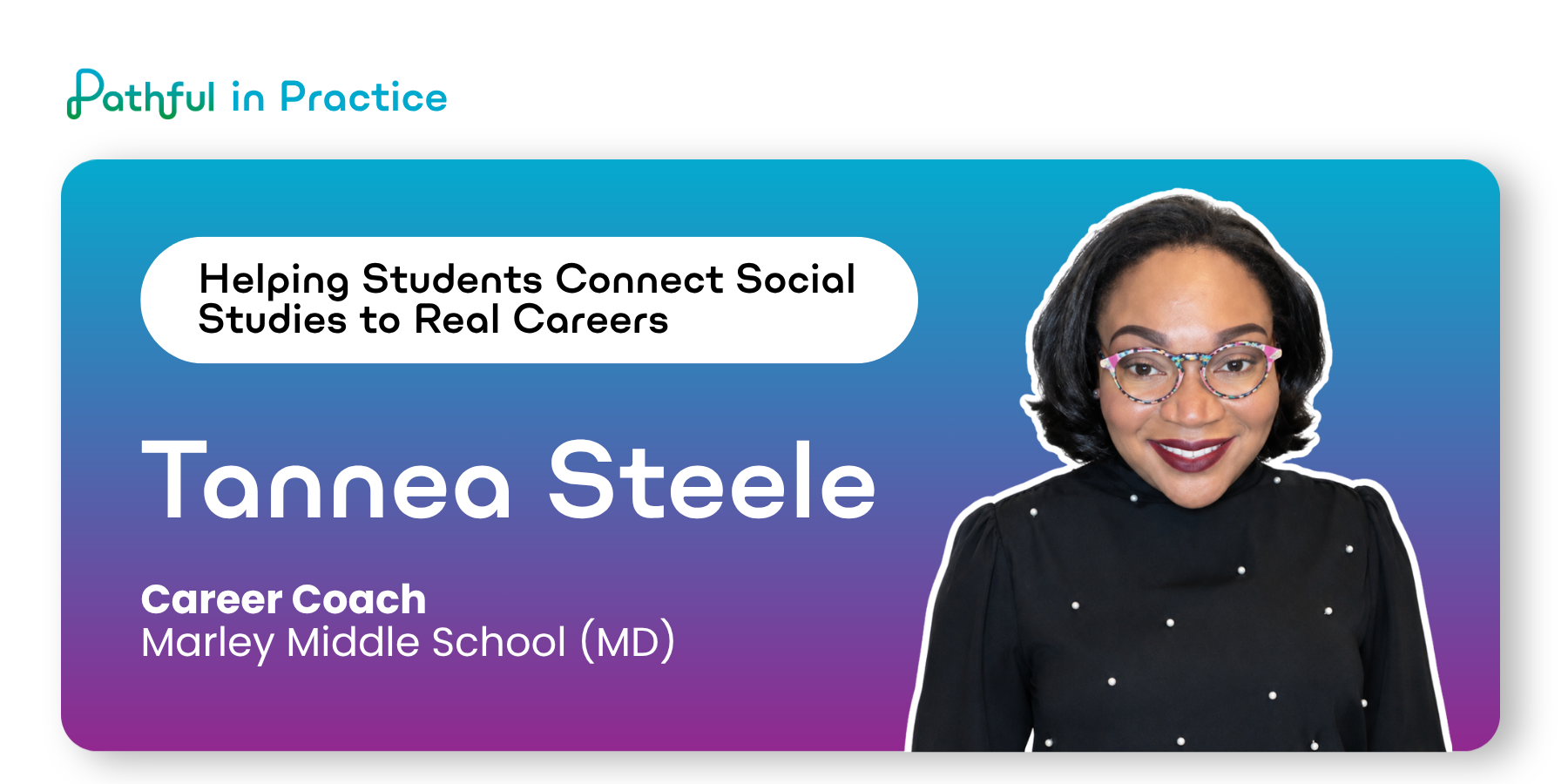
A Career Coach builds career exploration directly into Social Studies instruction, turning students into “Junior Sociologists” who research a career and build a one-pager on what they find.
The context
At Marley Middle School, Tannea Steele serves as a Career Coach, a role focused on helping students build early awareness of careers and making connections between what they are learning in school and what comes next.
Her work is not tied to a single classroom or subject. Instead, she partners with teachers, supports classroom instruction, and creates opportunities for students to explore careers in ways that feel relevant and accessible.
That also means working within the reality of a middle school schedule. Time is limited, and career exploration cannot feel like something extra that competes with core instruction.
As Tannea put it, “I'm not always the one leading a full class period. A lot of the time, I'm finding ways to support what teachers are already doing.”
In Social Studies classrooms, she noticed a consistent pattern. Students were engaging with topics like communities, systems, and historical change, but they were not always connecting that learning to real-world roles.
“They're learning about people and systems, but they're not always thinking about where that shows up in real life.”
That gap became the starting point for a more integrated approach.
The strategy
Instead of introducing career exploration as a separate activity, Tannea builds it directly into Social Studies instruction.
She works with teachers to frame the subject as a field that already includes a wide range of careers. Roles like sociologists, historians, political scientists, and urban planners are introduced as natural extensions of what students are learning.
From there, students take on the role of “Junior Sociologists.”
Using Pathful, they explore a career connected to Social Studies and begin building a more complete understanding of what that work involves. The goal is not to move quickly through multiple careers, but to spend enough time with one to make it feel real.
As Tannea shared, “I want them to think about whether they could actually see themselves doing this, not just what the job is.”
How it comes together in the classroom
This approach is designed to be flexible enough to work within an existing class period, whether Tannea is leading the activity or supporting a classroom teacher.
She typically begins by grounding the lesson in a specific example, often walking through what a sociologist does and why that role exists. This helps students see that Social Studies is not just content, but a field that connects to real work.
Students then use Pathful to explore a career of their choice. During this time, the focus is on depth rather than speed. Students are encouraged to look beyond basic descriptions and consider questions like:
- What does a typical day in this role look like?
- What kind of environment would this person work in?
- What kind of education or training is required?
- Is this the type of work I would enjoy doing regularly?
To bring their learning together, students create a one-pager that captures key takeaways about the career. This provides a consistent structure while still allowing for individual interests and reflections to come through.
Because the activity fits within a single class period, it can be used periodically throughout the year without disrupting pacing.
What students take away
Over time, Tannea has seen a shift in how students engage with both the content and the idea of careers.
Students often begin by approaching the activity as an assignment, but as they explore, they start to ask more specific questions and make comparisons between different roles. They also begin sharing what they find with each other, which naturally expands what the group is exposed to.
Some of the most meaningful moments come from simple realizations.
Tannea recalled one instance where a student reacted to the idea of a sociologist by saying, “Wait, people actually get paid to study communities?”
That reaction led to a broader conversation about how research connects to real-world impact, including how communities are studied, how decisions are made, and how systems change over time.
Moments like that help students move from seeing careers as abstract ideas to something more concrete and possible.
Why this works
This approach works in part because it does not require teachers to set aside time for a completely separate career lesson.
Instead, it builds on what is already happening in the classroom and adds a layer of relevance to it.
It also supports the broader goals of Tannea's role as a Career Coach. Rather than delivering one-off experiences, she is able to create repeated, embedded opportunities for students to explore careers across different subjects.
In a middle school setting, that consistency matters.
Many students have limited exposure to careers beyond what they see in their immediate environment. By using Pathful in this way, students are introduced to a wider range of possibilities and given a structured way to explore them.
Just as importantly, they begin to reflect on their own preferences, not just what sounds interesting on the surface.
How to try it
This approach can be implemented in small, manageable ways.
- Start by identifying a career that naturally connects to your current unit
- Introduce it as part of the content you are already teaching
- Give students time to explore that role using Pathful
- Ask them to capture what they learned in a simple format like a one-pager
- Build in a few minutes for students to share what they found
This can be done occasionally throughout the year and does not need to be a major shift in instruction.
The impact
For Tannea, the value of this approach is not just in the activity itself, but in how it changes the way students think about what they are learning.
As she put it, “Once they start seeing the connection, the conversations change.”
Students begin to move beyond completing the assignment and start thinking more about how their interests, their learning, and potential careers might align.
Over time, those moments build a stronger sense of awareness and help students begin to see where they might fit.
🤝 Have a strategy that's working for your students? Tell us about it for a chance to be featured in Pathful in Practice.
Was this article helpful?
Thanks for letting us know!

Keep exploring.
Can't find what you need?
Our support team is here to help you make the most of Pathful.