
Career exploration gives young students a concrete hook for the kind of self-reflection that abstract SEL prompts often can't reach. Here's where Pathful Junior overlaps with the competencies your SEL work already builds toward.
Ask a young student what they're good at and you'll often get a shrug, or “video games.” Self-awareness is one of the hardest things to teach directly at this age. Students don't yet have the words for what they're drawn to or what comes easily to them.
Now watch that same student react to a video of a marine biologist tagging a shark, or a chef plating a dish. “I want to do that.” “No way, that's gross.” “How do they even know how to do all that?” In each of those reactions, the student is telling you, and telling themselves, something about who they are.
Career exploration gives young students a concrete hook for the kind of self-reflection that abstract prompts often can't reach. SEL work, whatever curriculum or framework your school uses, tends to build toward the same handful of things: knowing yourself, managing yourself, understanding others, getting along with others, and making good choices. Schools that use the CASEL framework will recognize these as its five competencies. This article shows where career exploration overlaps with that work and how a few Pathful Junior tools help you make it intentional.
That overlap splits into two places. The competencies a student sorts out on their own, knowing yourself most of all, get direct help from the tools here, because Pathful Junior is built to surface interests and strengths and let a student make something of them. The competencies that live between people, understanding others and getting along with others, get their practice in how students talk about careers together: reacting to each other's choices, noticing a classmate light up at a job they'd skip, arguing over which one is best. Knowing yourself gets the most attention below, since that's where the tools do the most direct work. The rest surfaces along the way.
Reacting to careers is how young students practice knowing themselves
The Interest Assessment is the most direct self-awareness tool in Pathful Junior. It's emoji-based, so students respond to what appeals to them without needing to read dense text or explain themselves in words they don't have yet.
In K–2, you facilitate. Read the prompts aloud, let students respond to the emojis, and talk through the results together. Even at this age, students start to hear themselves described: “you liked the building activities, and you liked working with animals.” For a lot of young students, hearing their own preferences named back to them is new.
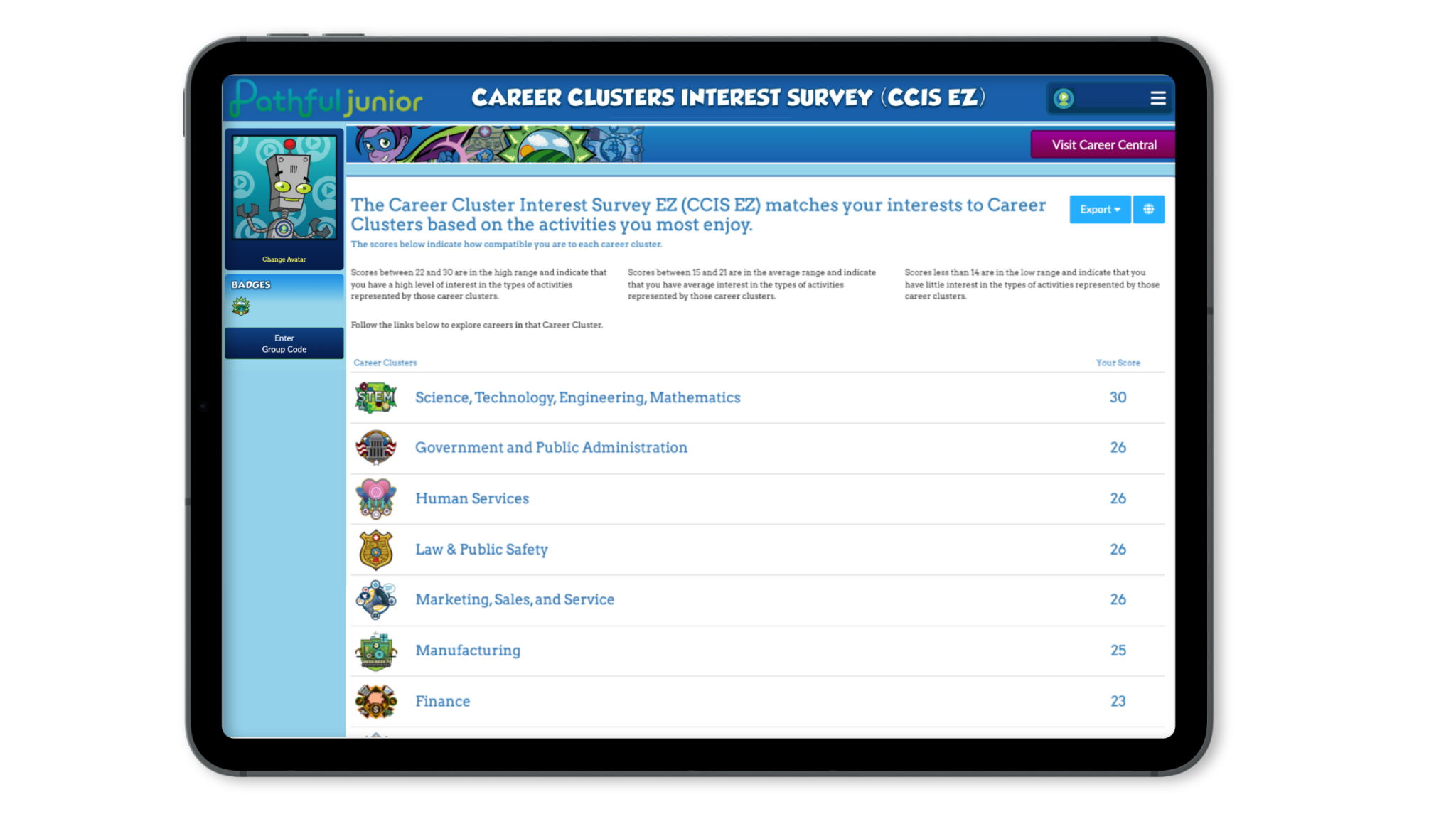
In grades 3–5, students take the assessment independently and view their own results. The self-awareness work happens in the conversation after. Ask them: does this sound like you? What surprised you? What would you add? A student who can look at a result and say “that part's right, but I also really like art” is doing exactly the kind of self-assessment SEL work is after.
Seeing what people do builds an understanding of others
Career Central holds profiles for more than 500 careers, most with a short, engaging day-in-the-job shadowing video, along with descriptions that cover what the work involves and what it takes to get there. Students meet people doing work they've never heard of, in places they've never pictured.
In K–2, browse Career Central on the projector and narrate. Ask who this person helps, and students start to see how much people depend on each other's work. A follow-up about whether the job is done with a team or mostly alone gets them noticing that work has a shape: some of it shoulder-to-shoulder, some of it quiet and solo. Ask whether anyone thinks they'd be good at it, and a student gets to try on the idea that a job could one day be theirs. Linger on someone whose look or background cuts against what students expect from that job, and you loosen the assumptions they already carry about who gets to do what.
In grades 3–5, students browse independently. Point them toward careers outside what's familiar, then give them something to look for past the title. Is this a job you'd do in a group or by yourself? Indoors or outside? Calm or high-pressure? Those questions help a student start matching real work against how they like to operate. The profiles also show what a job takes: the schooling, the training, the certifications. For a student who assumes people are simply born able to do things, seeing that a marine biologist studied for years is a small but real lesson in how skills get built.
Reflection turns a reaction into self-knowledge
A reaction on its own passes quickly. The self-knowledge comes when a student can say why they reacted the way they did.
In K–2, reflection stays verbal and visual. After watching a career video, have students draw the part of the job they'd most want to try, then tell you about their drawing. You're helping them put words to a preference they can feel but can't yet write.
In grades 3–5, the Career Journal is where that happens. Students can type into it and return to it independently, so reflection builds over time instead of living on a single worksheet. What you ask the class before students open it shapes what they get out of it. Pose a simple question first, like why one career appealed to them and why another left them flat, and the writing that follows draws out interest. Ask what would be hard about a job and how someone might handle a rough day of it, and a student starts weighing the harder parts of the work alongside the fun ones before they even start typing. Ask what it would take to get good at it, and the long road of effort behind any career comes into view. None of these questions has a right answer, which is what makes them safe to sit with.
Career Central profiles also include a one-to-ten rating students can give each career. On its own it's just a number. Over a few weeks, the pattern of what a student rates high becomes something you can point to: “you keep putting the hands-on, building jobs at the top. What does that tell you about yourself?”
This fits inside the SEL work you're already doing
Most schools already run a dedicated SEL curriculum, whether that's Second Step, the Zones of Regulation, or a homegrown morning-meeting routine. Career exploration doesn't compete with any of that. It gives the self-awareness strand of what you're already doing a concrete thing to work on, and it gives your class something worth talking about.
When students react to careers out loud, they practice the social side of SEL in real time. They listen to a classmate who loves a job they find boring. They disagree without shutting down. They notice that people want different things, and that this is fine. A counselor running a small group on strengths can open a Career Central video and ask which parts of that job each student thinks they'd be good at. A classroom teacher can tie a morning-meeting check-in to something a student found in the Interest Assessment. The SEL goal stays the same across both settings. Career content gives students something specific to reflect on and to talk through.
The goal is self-discovery, not a career choice
By the end of elementary school, a student who has done this work has learned something they didn't know about themselves: an interest they hadn't named, a kind of work they hadn't pictured wanting to do. Long before they choose anything, they're building the self-concept SEL work sets out to build.
Next time you run the Interest Assessment, ask one question after the results come up: what's something here you hadn't thought about before? A student who finds even one surprise in their own results is learning something new about themselves, not just hearing back what they already knew.
Was this article helpful?
Thanks for letting us know!

Keep exploring.
Can't find what you need?
Our support team is here to help you make the most of Pathful.