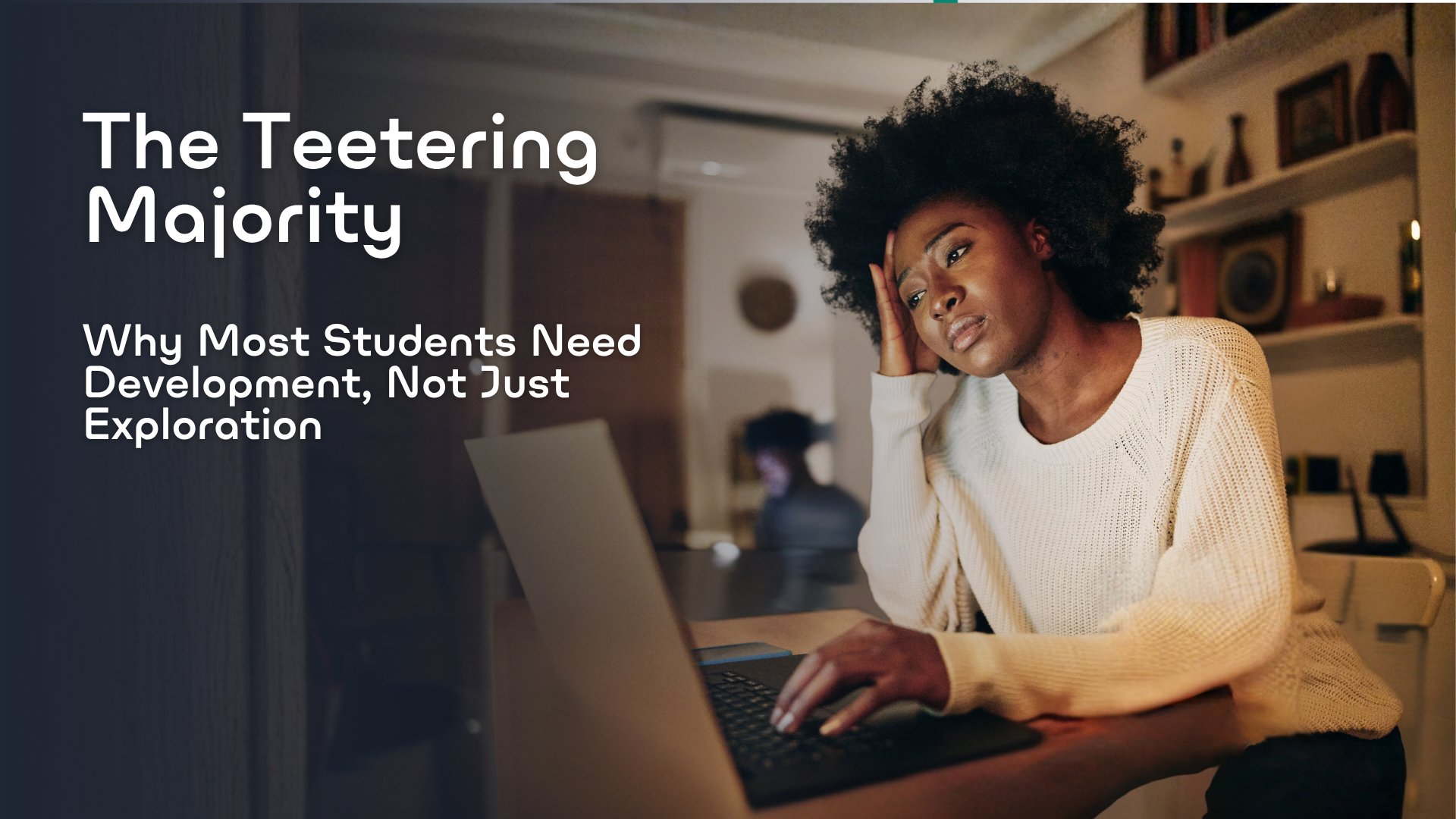
The Teetering Majority: Why Most Students Need Development, Not Just Exploration
Discover why 55% of students are "teetering"—not lost, but stuck between interests and action. Stanford research reveals that traditional career exploration fails the majority of students who need structured development, not just more options. Learn how Career Readiness & Development bridges the gap between student aspirations and real-world success.

In 2008, Stanford researcher William Damon published findings that should have transformed how we prepare students for careers. After interviewing hundreds of young people, he discovered that only about 20% were thriving—developing clear direction for their lives with genuine engagement in activities they loved. Another 25% were completely rudderless, at serious risk of never fulfilling their potential.
But here's what mattered most: The remaining 55%—the majority—were teetering. Not lost, but stuck. Not failing, but not launching either.
Damon identified two distinct groups within this majority. The "dabblers" pursued strings of disconnected interests with no real commitment. The "dreamers" had aspirations but no realistic plans or understanding of what success would actually require. Different problems, but the same outcome: young people struggling to convert interests into actionable career pathways.
That was 2008. The problem hasn't improved since then—it's intensified.
Today, 57% of 18-24 year-olds live with their parents, up from approximately 50% in 2005. Only about half of young adults aged 16-24 are employed. More concerning, approximately 11% of young adults are classified as NEETs—neither in employment, education, or training—representing over 4 million young people struggling to establish a foothold in adult life.
These aren't just statistics about 'kids these days.' These are your students—the ones graduating this year, the ones who graduated three years ago. The ones whose parents call you asking why their child seems stuck. This isn't a distant societal problem. It's happening in your district, with your students, right now.
Today's students face even more complexity than Damon's subjects did: rapid technological change, evolving career paths that didn't exist a decade ago, an overwhelming abundance of options, and economic uncertainty that makes every choice feel higher-stakes. Yet our approach to career readiness has largely remained the same: interest inventories, career profiles, salary data, and college planning tools.
We've had over 15 years to solve the problem Damon identified. We haven't. And the reason is simple: we've been focused on exploration when students needed development.
What Purpose Actually Requires
Damon's research revealed something critical: the students who were thriving had developed a clear sense of purpose—not just interests, not just dreams, but purpose. And purpose, he found, requires two things working together:
Personal passion - meaningful engagement with something that matters to you
Actionable commitment - realistic understanding of what's required and a plan to get there
The dabblers have interests but no direction. The dreamers have aspirations but no grounding in reality. Both lack the connection between what excites them and how to actually pursue it.
Sound familiar? That student who's taken your career class three times but still can't name a single career path? The dabbler. That senior who talks passionately about changing the world but hasn't applied to a single program? The dreamer. They're not lazy. They're not unmotivated. They're teetering—and they need something we haven't been giving them.
This is why traditional career exploration falls short. Showing students career profiles and salary data addresses neither component. Interest inventories might spark curiosity, but they don't build purpose. Students need to see the bridge between "this interests me" and "this is how people actually do this work."
The Missing Link: Authentic Professional Connection
The Purpose Formula: Here's what Damon discovered about young people who found purpose: they recognized a need in the world that called for action, and they developed a personal desire to address it through work that was meaningful to them.
Purpose emerges at the intersection of contribution and personal fulfillment.
This is where Career Readiness & Development diverges from traditional College and Career Readiness. It's not enough to help students explore options. We need to help them understand:
- What problems does this career actually solve?
- What does success in this field really look like on a daily basis?
- What skills and experiences do professionals wish they'd developed earlier?
- How do people in this field describe their path—not the idealized version, but the real one?
Students need to see themselves in the work through the eyes of people actually doing it. They need to understand both the contribution and the reality—the meaningful impact and the day-to-day challenges.
The research on young adults struggling to transition to independence consistently points to the same issue: they lack confidence in their ability to handle adult responsibilities because they haven't had opportunities to practice with guidance. They avoid challenges that feel insurmountable because they have no realistic framework for understanding what success requires. Traditional career exploration doesn't solve this—it might even make it worse by presenting endless options without showing students how real people navigate them.
From Interest to Action: What Students Actually Need
The 55% who are teetering don't need more career options to browse. They need structured pathways that help them:
For the Dabblers - Convert scattered interests into focused exploration by seeing how different careers connect to common themes and transferable skills. When a student interested in "working with people" sees a sports psychologist, a dental hygienist, and a manufacturing plant supervisor all describe their work, patterns emerge. Real professionals reveal the through-lines that assessments miss.
They need to understand that dabbling isn't the problem—it's dabbling without synthesis. Career Readiness & Development helps them connect the dots between disparate interests by showing them how professionals combine multiple skills and passions in unexpected ways. The engineer who creates scents. The STEM graduate in advanced manufacturing. These aren't random jobs—they're examples of how interests converge into careers.
For the Dreamers - Ground aspirations in reality by understanding what's actually required. A student dreaming of being an influencer needs to hear from someone running a successful content business about the strategic thinking, analytics expertise, and business development skills involved. Not to discourage the dream, but to clarify the actionable path toward it.
They need to see the gap between "I want to do this" and "here's what doing this actually entails." When a student with vague aspirations toward "helping people" meets a professional who describes their daily challenges, required skills, and realistic timeline to competence, the dream either crystallizes into commitment or evolves into something more aligned with who they actually are.
For Both - Bridge the gap between "this could be interesting" and "this is how I prepare." Virtual job shadows, live professional connections, and industry-led projects show students not just what careers exist, but how people got there and what they do every day. This is the actionable component Damon identified as essential to purpose.
Years later, we finally understand why traditional approaches fail: they ask students to imagine their futures without giving them the reality checks that make those futures achievable. They encourage dreams without building the confidence that comes from understanding what success actually requires.
Purpose Through Contribution
Damon emphasized something else crucial: young people need to hear "it's not about you" and discover careers as service to the world beyond themselves. This isn't about dismissing personal ambition—it's about connecting it to contribution.
When a student interested in gaming meets a cybersecurity professional who describes protecting people's personal data as "being a superhero in the cyber world," something clicks. The interest remains, but it's now connected to impact. When a STEM-curious student discovers someone creating scents for everyday products, they see how technical skills solve real human problems in unexpected ways.
This is perhaps the most important evolution in our understanding since Damon's research. The students struggling to transition to adulthood often report feeling that potential careers are meaningless or disconnected from anything that matters. They're not lazy—they're searching for significance and finding only salary data and job growth projections.
Traditional platforms show students what jobs pay and which ones are growing. Career Readiness & Development shows them what problems they could solve and whose lives they could improve—which is what actually builds purpose. It answers not just "what could I do?" but "why would I want to do it?"
The Scale Problem Traditional Approaches Can't Solve
Schools and districts serving thousands of students can't possibly arrange individual job shadows, workplace visits, and professional mentoring relationships for every student at scale. Yet these are precisely the experiences that help teetering students find direction.
This is the fundamental reason the problem has persisted for over 15 years: we've known what students need, but we haven't had the infrastructure to deliver it. We've settled for exploration tools—interest inventories, career databases, salary calculators—because those scale easily. But they don't solve the problem.
Career Readiness & Development requires more than curriculum—it requires infrastructure. We designed Pathful specifically to deliver what the research says students actually need:
- 60,000+ professionals across 5,000+ companies available for live virtual sessions
- Job shadowing videos that bring authentic workplace experiences into every classroom
- Industry-led projects that connect academic learning to real workplace applications
- Systematic tracking of work-based learning hours and experiences
- Tools that help students plan pathways based on actual market data and real professional insights
It's the difference between telling a student "research careers that interest you" and showing them dozens of professionals in related fields describing their actual work, then connecting them live with someone who answers their specific questions. The first approach hasn't worked for over 15 years. The second is Career Readiness & Development.
Converting the Teetering Majority
The 20% who are already thriving will likely find their way regardless of what systems we put in place. The 25% who are completely lost need intensive intervention that goes beyond any single platform.
But that 55% in the middle? They're the students Career Readiness & Development can transform at scale. They have enough direction to engage, enough curiosity to explore, and enough ambition to pursue—they just need structure, reality, and connection to bridge the gap between interest and action.
They need to see how careers connect to contribution. They need to understand what pathways actually require. They need access to professionals who can show them both the meaningful impact and the practical reality of different fields.
They don't need more exploration for exploration's sake. They need development—progressive, structured, authentic development that converts dabbling into commitment and dreams into realistic plans.
That's not college and career readiness. That's Career Readiness & Development. And it's what the majority of students have needed all along.
The research told us what students needed in 2008. The statistics show we haven't solved it. The question isn't whether we understand the problem—it's whether we're finally ready to build the solution.
The 55% are waiting. What will you do differently for them this year?
Key Sources:
- Damon, W. (2008). The Path to Purpose: How Young People Find Their Calling in Life
- Stanford Profile: William Damon
- Stanford News: Sense of Purpose in Young Driven by Action and Passion
- Bowling Green State University - Young Adults in the Parental Home, 2007-2023
- U.S. Bureau of Labor Statistics - Employment and Unemployment Among Youth
- Measure of America - NEET Statistics
- U.S. Department of Education - Young Adults Neither Enrolled nor Working

Why Career Readiness Can't Wait


.webp)