
From Policy to Classroom: How Federal and State Changes Are Helping Students Build a Plan for Life After High School
From Perkins V to statehouse diploma redesigns, the policy landscape is shifting fast — and the question at every level is no longer whether students graduate, but whether they're ready for what comes next.
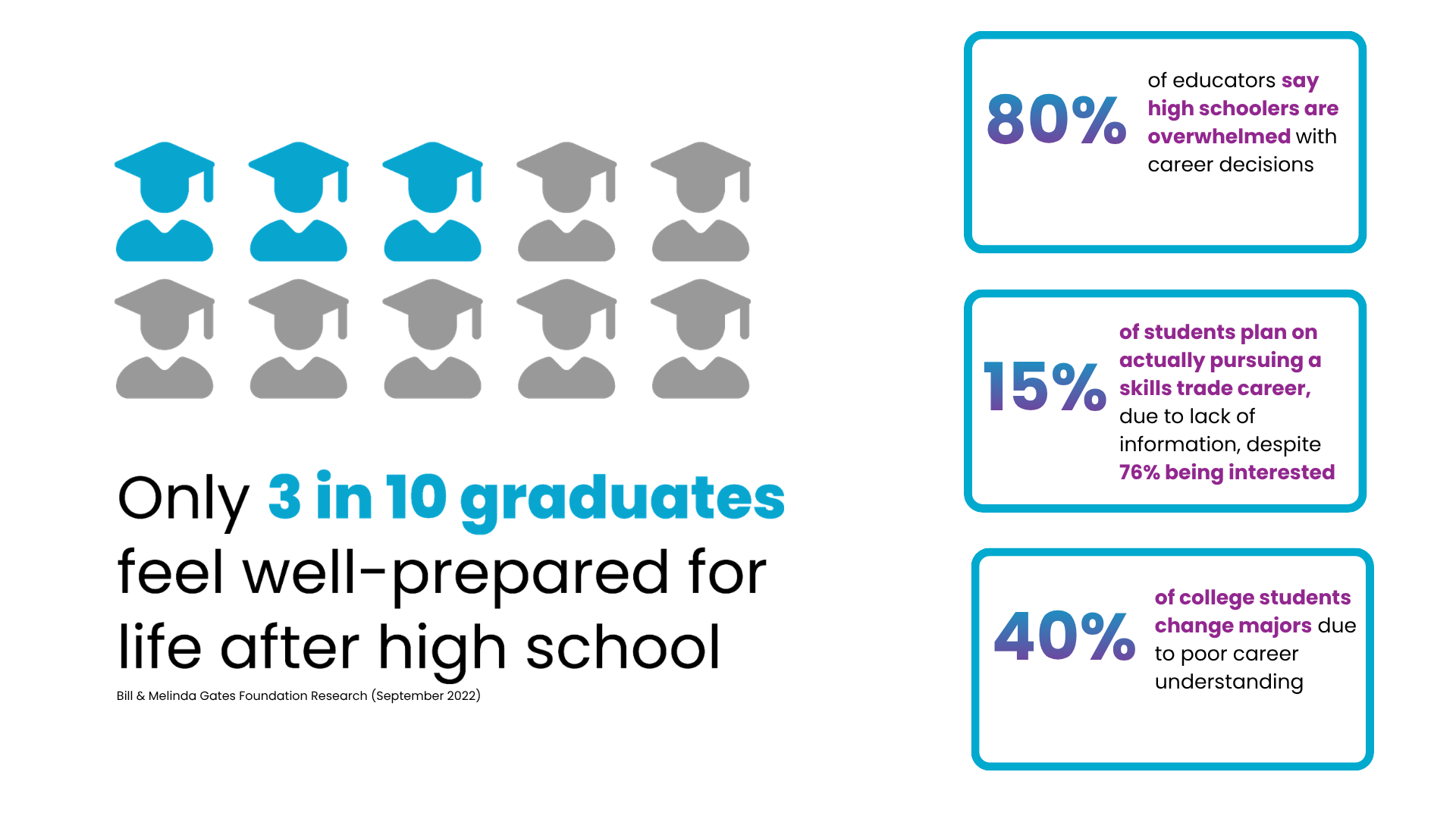
Something has fundamentally changed about how the United States thinks about preparing students for what comes after graduation. In the past five years, that change has moved with unusual speed through the full chain of American education — from the halls of Congress to state capitols, from district leadership teams to individual classrooms, and ultimately to the students themselves. The question being asked at every level is no longer simply whether students are graduating. It is whether they are ready for what comes next.
The answer, more often than not, has been no. But the policy landscape is being restructured to change that.
What changed at the federal level
The recent federal legislation driving this shift is the Strengthening Career and Technical Education for the 21st Century Act, known as Perkins V, which was signed into law in July 2018 and has been actively shaping district behavior ever since. Perkins V provides approximately $1.4 billion annually to support CTE programs at the secondary and postsecondary levels, but its significance goes well beyond the dollar amount. The law formalized a set of performance indicators that states and local districts must track and report, covering not just graduation rates but postsecondary placement, credential attainment, work-based learning participation, and equity outcomes for special populations.
Equally important is what Perkins V requires before any application is submitted: the Comprehensive Local Needs Assessment, or CLNA. This biennial process asks districts to examine their CTE programs across multiple dimensions simultaneously, including student performance data, labor market alignment, program quality, and progress toward equity. When conducted with genuine stakeholder engagement and honest data analysis, it forces district leaders to ask hard questions about whether their programs are serving students or simply existing on a schedule.
The Every Student Succeeds Act created additional leverage by giving states the flexibility to include career readiness indicators in their accountability systems. As of 2025, 43 states include at least one career-focused indicator in their state and federal accountability systems, a substantial expansion from earlier years and a direct result of states exercising ESSA's fifth indicator provision. This means that Career Readiness and Development is no longer an enrichment activity sitting outside the accountability conversation. In dozens of states, it is part of how schools are evaluated.
This year the U.S. Department of Education moved to further cement workforce alignment as a federal priority. In spring 2026, the Department finalized Supplemental Priority Definitions on Career Pathways and Workforce Readiness, codifying the current administration's emphasis on connecting K–12 education directly to labor market outcomes. The administration has also signaled that expanding Perkins V frameworks alongside the Workforce Innovation and Opportunity Act could create new pathways to prioritize apprenticeship programs and workforce readiness, with potential expansion of Pell Grant eligibility to include short-term workforce training.
How states have responded
State-level responses have varied widely and, in many cases, have been decidedly proactive. Thirty-eight states updated their graduation requirements in 2022 or 2023 alone, while only six states had not updated their requirements since before 2020. The pattern across these updates reveals a clear direction: states are adding Career Readiness and Development components to what it means to earn a diploma, requiring individualized planning, and expanding access to work-based learning.
Today, a large and growing number of states mandate some form of individual career or academic planning for students, with requirements spanning grades 6 through 12 in many cases. These plans go by different names, including Individual Career and Academic Plans (ICAPs), Individual Learning Plans (ILPs), Next-Step Plans, and Education and Development Plans, but they share a common purpose: to create a living, student-centered document that guides course selection, career exploration, and post-secondary decision-making across the full span of a student's secondary education.
In 2025 alone, states enacted 20 more CTE-related policies than in 2024, with funding and industry partnerships/work-based learning tying for the top policy category, each drawing 67 enactments. Texas led all states with 15 individual CTE policy enactments in a single legislative session.
States leading the way
While the national trend is clear, several states have distinguished themselves through ambitious implementation efforts, providing valuable models for comprehensive, statewide adoption.
Indiana
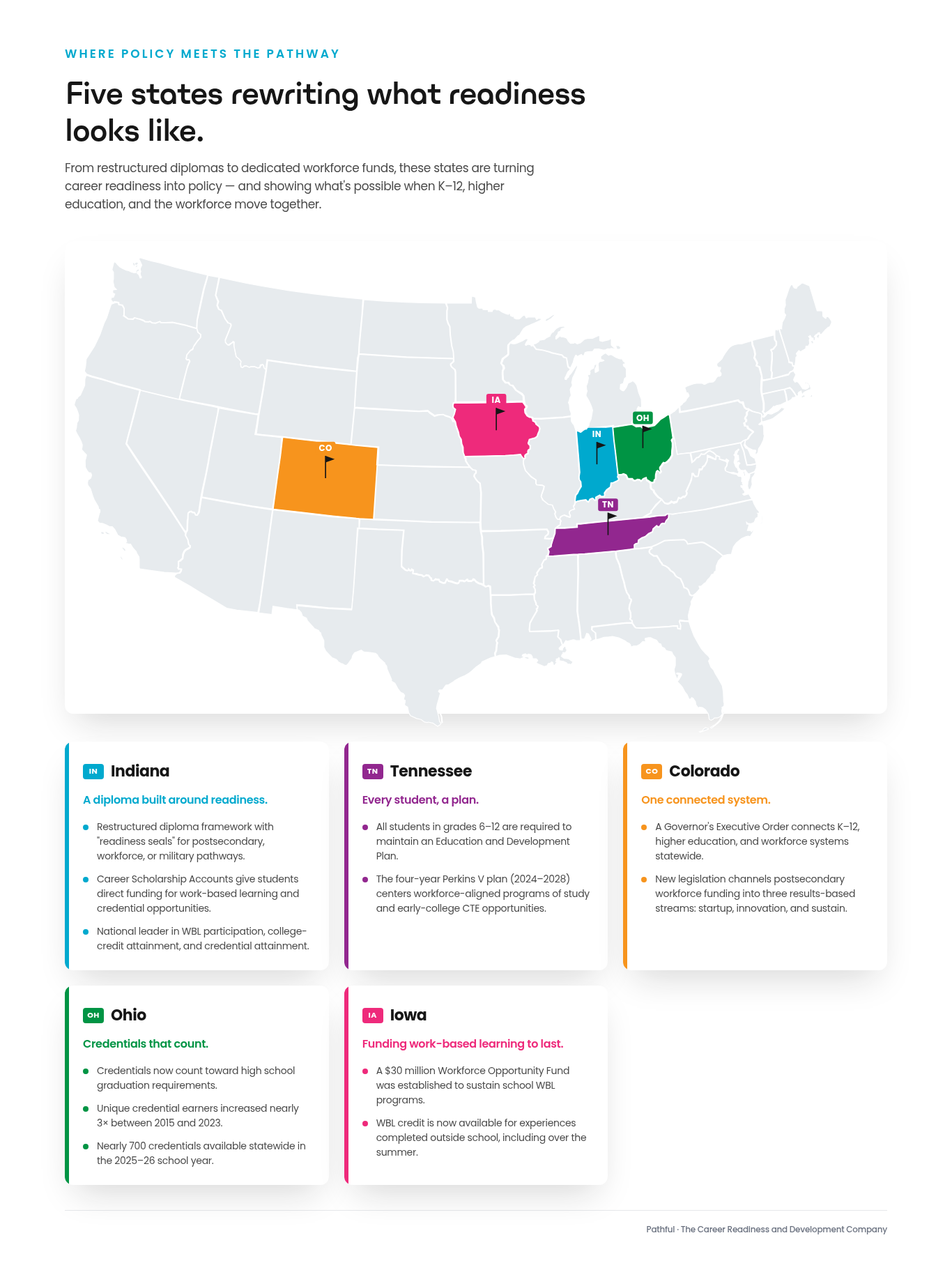
Indiana has become one of the most frequently cited examples of purposeful CTE policy integration. The state restructured its diploma framework to empower students to pursue readiness seals aligned with their post-graduation plans, whether that involves postsecondary enrollment, workforce entry, or military enlistment. The framework strengthens the connection between CTE and real-world skills by enhancing access to work-based learning opportunities and credentials of value, and the state committed to developing advising tools and accountability models as part of the rollout. Indiana's trajectory in work-based learning participation, college credit attainment, and credential attainment has drawn national attention, with its Career Scholarship Accounts providing students direct funding to access WBL, internships, and credential opportunities.
Tennessee
Tennessee has emerged as a leader in aligning Perkins V implementation with statewide workforce priorities, creating a more coherent pathway from education to employment. The state's four-year Perkins plan, running from 2024 through 2028, focuses on students concentrating in workforce-aligned programs of study, participating in Career and Technical Student Organization experiences, and beginning their postsecondary journeys through CTE-focused early college opportunities. Tennessee's mandate that all students in grades 6 through 12 maintain an Education and Development Plan means that career planning is embedded into the school experience from middle school onward, giving students years to explore, reflect, and refine their goals before graduation day.
Colorado
Colorado has pursued a systems-level approach. Governor Jared Polis signed an Executive Order designed to strengthen connections between K–12 education, higher education, and the workforce to provide students with more seamless pathways to meaningful careers, directing state agencies to collaborate on modernizing and integrating workforce systems. Colorado lawmakers also passed legislation that streamlines postsecondary workforce development funding into three streams: startup funding, innovation grant funding, and sustain funding. This approach focuses investments on programs that produce measurable student outcomes.
Ohio
Ohio has seen dramatic growth in credential attainment as a direct result of state policy changes that allow credentials to fulfill graduation requirements. The number of unique credential earners in Ohio increased nearly threefold between 2015 and 2023, with nearly 700 unique credentials available in the 2025–26 school year. This growth corresponds directly with state policy changes, including credentials as an option to fulfill high school graduation requirements and a targeted policy to increase credential earning in high-priority career fields.
Iowa
Iowa has tackled work-based learning at the funding level, establishing a $30 million Workforce Opportunity Fund to help schools sustain work-based learning programs and expanding WBL definitions to allow credit to be awarded for experiences occurring outside of school, including during summer months.
The gap between policy and practice
All of this policy momentum is genuine and meaningful, but it contains a critical vulnerability. Mandating that students have career plans does not automatically mean those plans are useful. Requiring work-based learning participation does not guarantee students get meaningful experiences. Policies create conditions; they do not create outcomes on their own.
The gap between what a policy requires on paper and what actually happens in a counselor's office or a CTE classroom is where most reform efforts stall. A student career plan that lives in a paper folder, updated once a year by a counselor with a caseload of 400 students, is not the same as one that the student actively owns, revisits, and uses to drive real decisions. This is precisely the challenge that platforms like Pathful are designed to address.
The Career Plan: where policy becomes personal
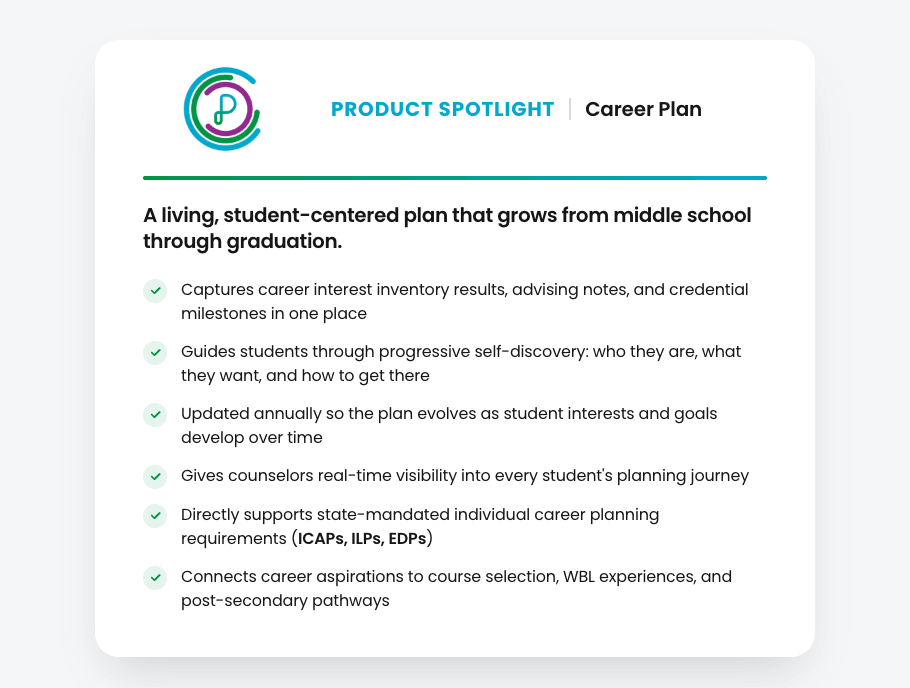
Pathful's Career Plan, formerly known as the Postsecondary Plan, is the product that sits at the center of Pathful's approach to student post-secondary planning, and it reflects a philosophy that the best policy frameworks are trying to build: that career planning should be a continuous, student-centered process that starts before high school and deepens every year.
The Career Plan gives students a structured, personalized space to document their interests, explore career possibilities, set short- and long-term goals, and track their growth across their entire secondary education journey. It integrates career interest inventory results, records of advising conversations, WBL participation, credential milestones, and course selection decisions into a single, accessible record that evolves alongside the student.
What distinguishes this from a compliance document is intentionality. Research is clear that structured, progressive career development interventions can reduce career decision-making difficulties by up to 50%. Students who build professional networks during their school years have 85% higher career placement rates. These outcomes do not emerge from a filled-out form. They emerge from a student who has spent years learning about themselves, connecting with professionals, and making increasingly informed decisions.
For counselors and administrators, the Career Plan also provides something policy requires but rarely delivers: visibility. When a counselor can see at a glance where each student is in their planning journey, which career areas they have explored, and which experiences they have documented, they can provide timely and targeted support rather than starting from zero in a 15-minute senior advising session.
Course Planner: connecting ambitions to academic choices
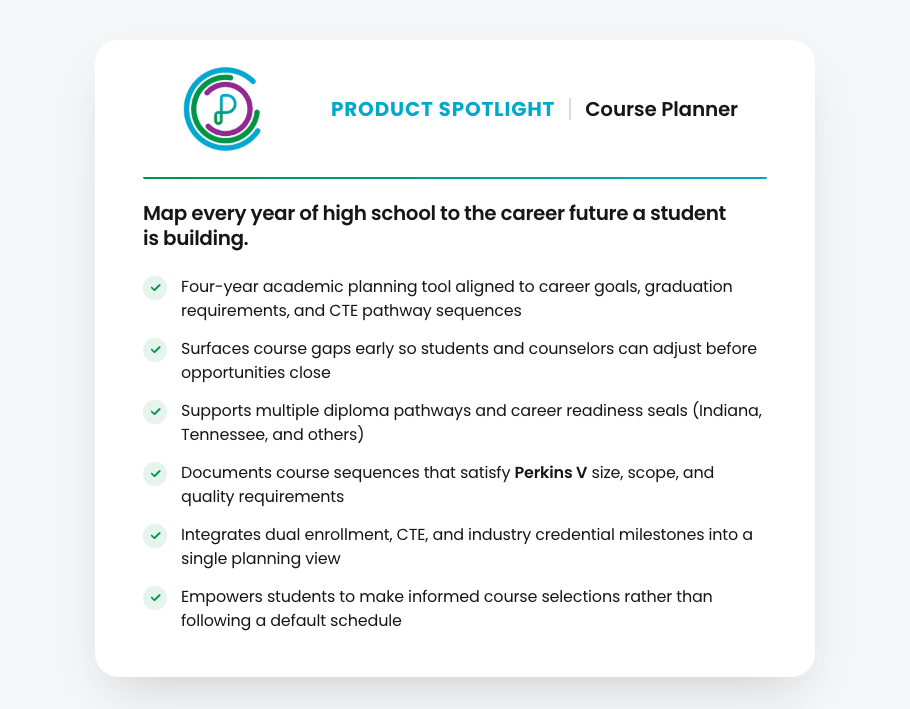
A career plan without aligned coursework is aspiration without architecture. Pathful's Course Planner addresses this directly by giving students a structured tool to map their full four-year academic journey in relation to their career goals and their district's program requirements.
If a student has identified an interest in advanced manufacturing through their career exploration, their course plan should reflect that, moving them toward CTE pathway courses, dual enrollment opportunities, and the sequences that lead to industry-recognized credentials. If that student's interests shift toward healthcare by junior year, the Course Planner shows what adjustments are needed and whether they are still achievable before graduation.
This kind of alignment is exactly what Perkins V's size, scope, and quality requirements ask districts to demonstrate. Programs of study must have clear course sequences, credential alignment, and a coherent progression from introductory to advanced coursework. The Course Planner gives students and counselors the infrastructure to build that alignment at the individual level, and gives districts the documentation they need to show that programs are functioning as designed.
For states that have adopted multiple diploma pathways or graduation seals tied to Career Readiness and Development activities, as Indiana and several others have done, course mapping is not optional. It is the connective tissue between a student's stated goals and their actual academic record.
JobreadyWBL and experience tracking: making real-world learning count
Work-based learning is the policy priority that is simultaneously the most universally endorsed and the most inconsistently delivered. Every state plan, every Perkins V application, and nearly every district strategic plan mentions WBL as a priority. Yet according to Pathful's research, only 21% of employers currently offer WBL opportunities, and the students who most need real-world career exposure are the least likely to access it.
The research case for WBL is unambiguous. Ninety-two percent of WBL participants report gaining experience that helps them in the workplace. Sixty-eight percent of WBL completers receive job offers. Students who build professional networks during their school years have 85% higher career placement rates. These are not marginal gains. They are transformational differences in student outcomes.
JobreadyWBL gives coordinators the infrastructure to make these outcomes achievable at scale. It supports the coordination of placements, the documentation of student hours and activities, employer partnership management, and the reporting that Perkins V performance indicators require. It handles the full WBL continuum, from career awareness activities all the way through cooperative education placements and pre-apprenticeship programs.
Critically, experience tracking connects back to the Career Plan. When a student completes a job shadow or finishes an internship, that experience does not disappear into a paper log in a coordinator's file drawer. It becomes part of the student's documented history, connected to the skills they are building, the career areas they are exploring, and the goals they have set. That continuity is what turns isolated experiences into a coherent development narrative.
How it all connects: a system, not a set of programs
The most effective districts are not treating career planning, course alignment, and work-based learning as three separate programs with three separate coordinators and three separate reporting systems. They are treating them as one connected student development ecosystem, with the Career Plan at the center and the Course Planner, JobreadyWBL, and experience tracking as the infrastructure that makes the plan real.
Federal policy, through Perkins V and ESSA, has created the accountability pressure for this kind of integration. State policies, from individual planning mandates to diploma redesign to WBL funding initiatives, have created the structural incentives. What remains is the practical challenge of implementation: ensuring that every student, regardless of their counselor's caseload or their district's size, has access to a structured, supported process for discovering who they are, understanding what opportunities are available, and building a plan that connects their present to their future.
As state leaders continue rethinking how education systems prepare students for success beyond graduation, the trend is clear: reducing barriers, expanding access, and directing resources to programs that deliver measurable results for students. Pathful is built to help districts deliver those results, from the Career Plan that sits at the heart of every student's journey to the Course Planner, JobreadyWBL, and experience tracking that give that journey structure, documentation, and real-world connection.
The policy direction is set. The question now is whether every student will actually feel it in their classroom, in their advising session, and in the plan they are building for the rest of their life.
Sources & citations
- Strengthening Career and Technical Education for the 21st Century Act (Perkins V), signed July 2018. U.S. Department of Education.
- Perkins V Application Toolkit. Pathful. Available on the Pathful Compass.
- New CTE Pathway Launch Playbook: A 12-Month Implementation Guide. Pathful. Available on the Pathful Compass.
- Why Career Readiness and Development Matters: Closing the Gap Between Graduate Preparation and Employer Expectations. Ryan Hagedorn and Alexandra Fuchs. Pathful, Inc.
- The WBL Management System Playbook, v1.0.9. JobreadyWBL by Pathful.
- Making Career Readiness Count: A 2025 Update, 10 Years of Measuring What Matters. Advance CTE and the College in High School Alliance. June 2025.
- State Policies Impacting CTE: 2025 Policy Examples. Advance CTE and the Association for Career and Technical Education. April 2026.
- Department of Education Finalizes Career Pathways and Workforce Readiness Priorities. Afterschool Alliance. May 2026.
- Education-to-Workforce Pathways: How States Improved Access, Alignment and Outcomes in 2025. ExcelinEd In Action. January 2026.
- From Classrooms to Careers: 7 States Strengthen Workforce Pathways in 2024. ExcelinEd In Action. January 2025.
- Indiana and Ohio Expand CTE Pathways with New Policies. Advance CTE. February 2025.
- College or Career Readiness? Postsecondary and Labor Market Outcomes for Ohio High School Students. Thomas B. Fordham Institute. March 2026.
- Changing Graduation Requirements for a Changing World. Education Commission of the States. April 2024.
- A State-by-State Guide to Individual Learning Plan (ILP/ICAP) Mandates. Edmentum. April 2026.
- Predicting Education Policy Shifts in 2025 and Beyond. District Administration. December 2024.
- Tennessee 4-Year Perkins V State Plan, FY 2024–2028. Tennessee Department of Education.
- Job Openings and Labor Turnover Summary, September 2025. U.S. Bureau of Labor Statistics.
- Reassessing ESSA Implementation: An Equity Analysis of School Accountability Systems. EdTrust. February 2025.
- Indiana Commission for Higher Education, CTE Education Readiness Grant Press Release. May 2025.

Keep reading.
From vision to verified
How state CTE leaders drive real career readiness — from policy intent to documented outcomes.
The complete Perkins V application toolkit
A step-by-step guide for CTE directors — CLNA templates for all five required elements, a budget worksheet, and the mistakes to avoid.
The complete work-based learning partnership builder
Cold outreach templates, internship agreement forms, a workplace mentor guide, and a partnership tracking system for WBL coordinators.
Ready to make career readiness more meaningful?
Let's talk about how Pathful can support your students and meet your goals.