
Work that actually matters: how Industry-Led Projects are changing what career readiness looks like
Career days and job shadows reach a fraction of students. Here is how Pathful's Industry-Led Projects bring authentic, employer-designed work into every classroom, regardless of zip code.
When we talk about preparing students for the workforce, we tend to default to the same framework: career days, job shadows, maybe an internship for a lucky few. These experiences are valuable, but they reach a fraction of the students who need them. The rest graduate with a diploma and very little sense of what real work actually feels like.
That is the gap that Pathful's Industry-Led Projects, or ILPs, are designed to close. And as someone who has spent nearly two decades working in education technology, I can say with confidence that ILPs represent one of the most meaningful shifts I have seen in how schools connect students to the world of work.
The traditional WBL and CTE model: valuable but limited
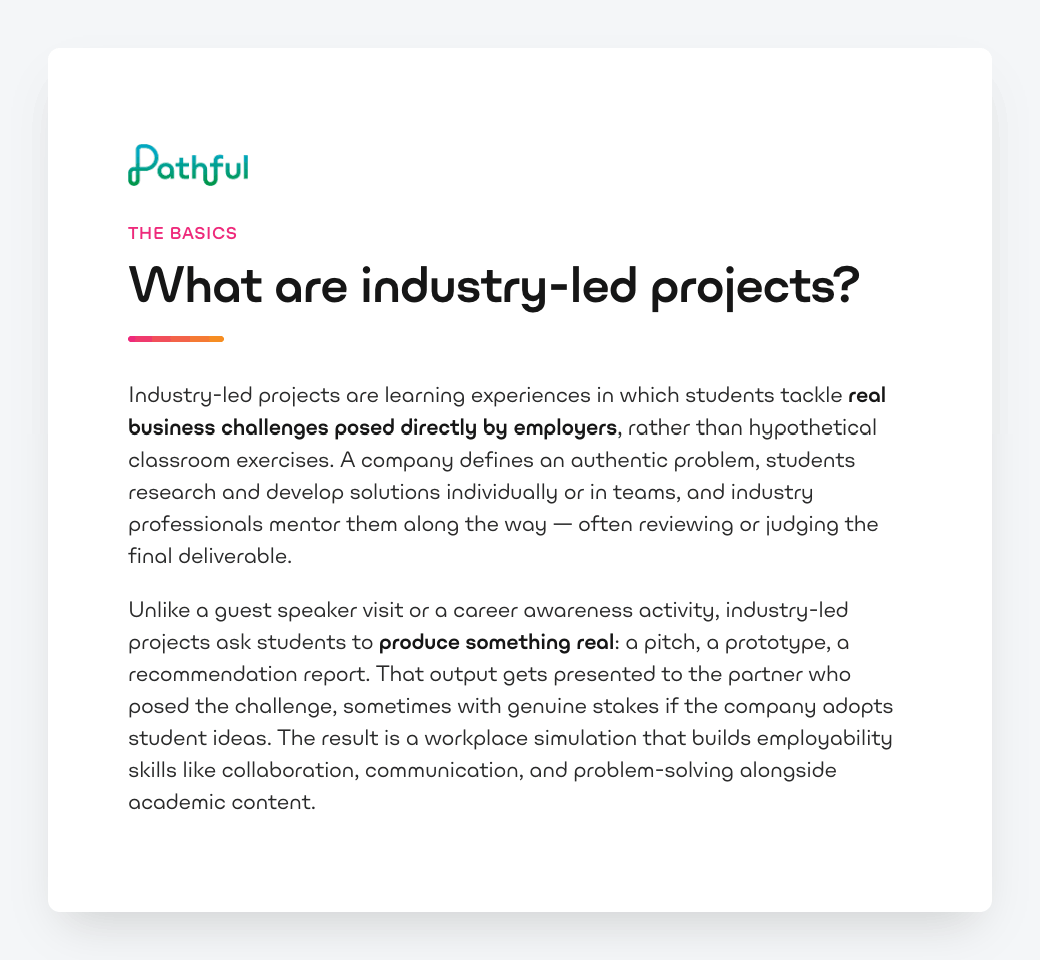
Work-based learning (WBL) and Career and Technical Education (CTE) programs have always been grounded in a powerful idea: students learn best when their education is connected to real careers and real skills. For decades, these programs have served as a critical bridge between the classroom and the workforce, and the data backs up their impact. Students who participate in high-quality CTE programs are more likely to graduate, more likely to be employed, and more likely to earn higher wages after high school.
But here is the honest challenge with the traditional model: it is built on proximity and logistics. A job shadow requires a local employer willing to host students. An internship requires transportation, scheduling flexibility, and often a personal connection to make it happen. In rural districts, under-resourced schools, and communities without dense employer networks, these experiences are simply hard to scale.
According to the Urban Institute, roughly 7.7 million students are enrolled in rural school districts nationwide. For many of them, traditional WBL experiences are not inaccessible because of a lack of interest. They are inaccessible because of geography and resource constraints. CTE programs also face the ongoing pressure of keeping curriculum relevant. Employer relationships require cultivation, and without dedicated staffing and coordination tools, even well-resourced districts struggle to deliver consistent, high-quality work experiences to every student, not just the ones who know how to navigate the system.
What makes ILPs different
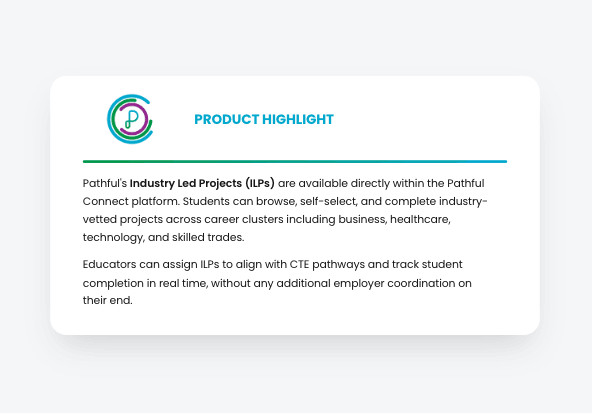
Industry-Led Projects were built to solve these exact problems. Rather than asking students to come to the workplace, ILPs bring the workplace to the student. These are structured, employer-designed projects that reflect the actual challenges, decisions, and workflows professionals encounter on the job. They are not simulations in the abstract sense. They are real problems, vetted by real industry partners, delivered through a platform that any school can access.
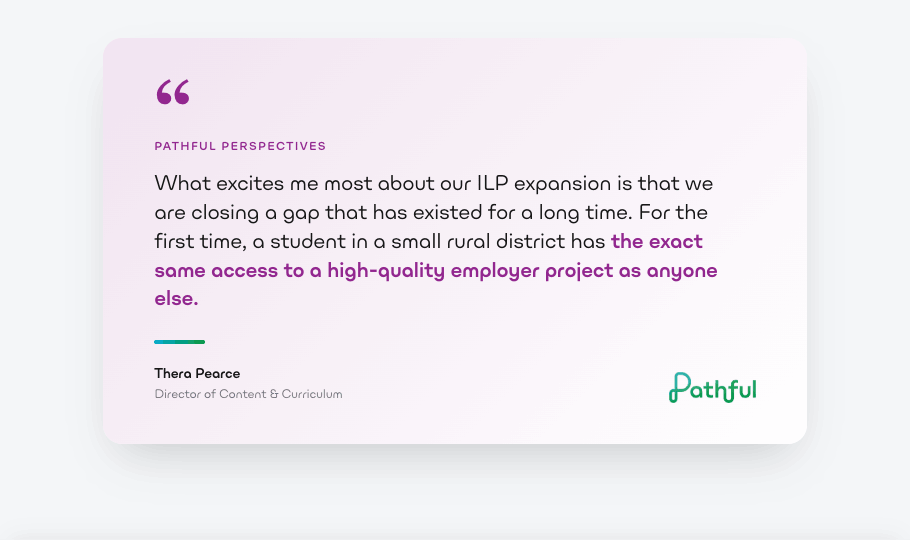
The flexibility this creates is significant. A student in a small town in rural Montana has the same access to a project designed by a Fortune 500 technology company as a student in downtown Chicago. A WBL coordinator does not need to spend hours prospecting employer partners or scheduling site visits. The curriculum is ready, the employer relationship is already built in, and the student can engage on a timeline that works for their school schedule.
This is not about replacing in-person work experiences. Job shadows, internships, and apprenticeships remain deeply important, and Pathful continues to support those pathways as well. ILPs are about expanding access, ensuring that every student, regardless of their zip code or their school's resources, can develop the kind of professional skills and career awareness that used to be reserved for the few.
Why authentic work exposure is not optional
The push for authentic work experiences in K-12 is not a trend. It is a response to a significant disconnect between what schools are delivering and what the workforce actually needs.
A 2023 report from the Society for Human Resource Management found that 74 percent of employers believe recent high school and college graduates are not fully prepared for the expectations of the modern workplace. The gap is not primarily academic. Employers consistently cite a lack of real-world problem-solving experience, professional communication skills, and the ability to work within structured teams and timelines.
Meanwhile, a growing body of research connects early, authentic career exposure to better student outcomes. Students who participate in work-based learning experiences demonstrate higher engagement, stronger academic performance, and a clearer sense of post-secondary direction. The Association for Career and Technical Education (ACTE) notes that students who complete CTE programs of study are more likely to graduate from high school than their peers, and early employer engagement is one of the most consistent predictors of that outcome.
The challenge is that high-quality, authentic experiences have historically been unequally distributed. Students with access to well-connected families, well-resourced schools, and employer-dense communities have always had advantages. ILPs are a structural solution to a structural problem. They do not rely on luck, geography, or who you know. They deliver consistency at scale.
Pathful's ILP library has grown significantly in the 2025-2026 school year
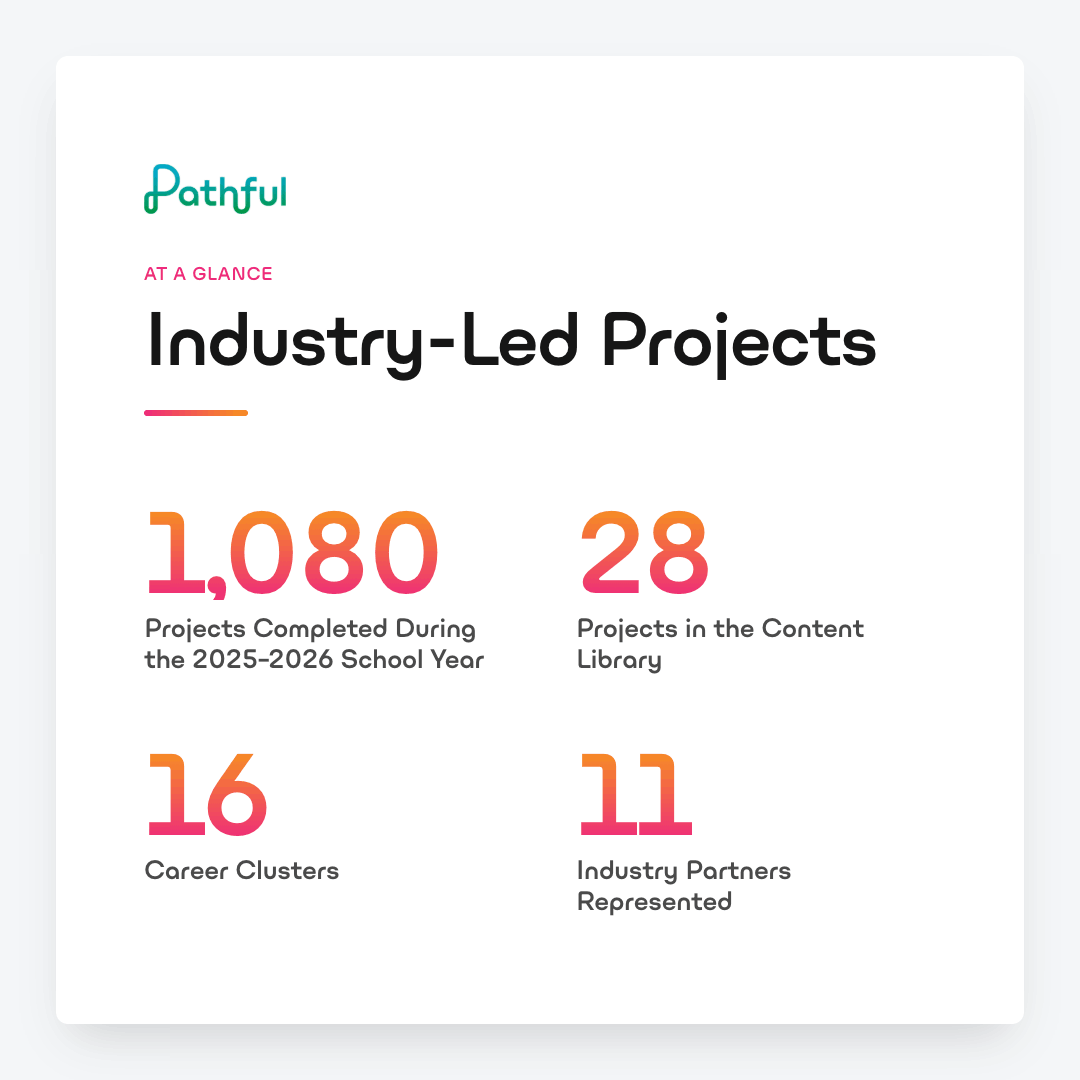
Pathful has made significant investments in expanding its ILP offerings this year, and the results reflect a growing commitment to both breadth and quality across career clusters.
New additions to the library include projects across emerging fields like artificial intelligence in business, green energy, and healthcare technology, reflecting where the labor market is heading and where student interest is growing. Pathful's curriculum team works directly with employer partners to ensure each project is grounded in current workplace realities, not a version of the industry that existed five years ago.
For WBL coordinators managing Perkins V compliance and program documentation, ILPs also offer a trackable, defensible record of work-based learning engagement. Every completion is logged within the platform, making it significantly easier to report on student participation for federal and state funding requirements.
What this means for educators on the ground
I talk to WBL coordinators and CTE directors across the country, and I hear the same thing consistently: the aspiration is there, but the bandwidth is not. They want every student to have a meaningful work experience. They want their programs to be current and relevant. They want to be able to show outcomes. But coordinating employer relationships, maintaining curriculum relevance, and managing logistics across a full caseload is an enormous lift.
ILPs do not replace the educator. They free them up to do the work that only they can do: building relationships with students, providing mentorship, and connecting kids to local opportunities. The scaffolding of the project — the employer relationship, the instructional framework — is already handled.
For districts pursuing or maintaining Perkins V compliance, ILPs align directly with the emphasis on work-based learning as a program quality indicator. They provide a scalable mechanism for meeting participation benchmarks without requiring the kind of employer outreach infrastructure that many smaller programs simply do not have.
The road ahead
Work-based learning is evolving. The definition of what counts as meaningful career exposure is expanding to include virtual experiences, employer-designed challenges, and project-based learning that mirrors how modern organizations actually operate. ILPs sit at the center of that evolution.
Pathful's goal has always been to make sure that career readiness is not something that happens to some students. It should be something that every student can access, regardless of their school's size, location, or resources. The expansion of our ILP library this year is a step toward that, and it is one we are proud of.
If you are a WBL coordinator or CTE director interested in seeing how ILPs can fit into your program, we would love to show you. The access is already there. The only question is how far you want to take it.
Sources
- Society for Human Resource Management (SHRM). White Paper on Strengthening the Path from Education to Employment. 2026.
- Association for Career and Technical Education (ACTE) / Office of Career, Technical and Adult Education (OCTAE). 2023-24 Perkins Data. November 2025.
- Association for Career and Technical Education (ACTE). CTE Is Good for Students, Good for Businesses and Good for Communities. January 2025.
- Urban Institute. Small and Sparse: Defining Rural School Districts for K-12 Funding. 2023.
- Jobs for the Future (JFF). Pathways to Prosperity Levers: Work-Based Learning.
- Strada Education Foundation. The Power of Work-Based Learning.

Keep reading.
From guidance office to career path
How career readiness platforms give counselors scalable tools for undecided students.
The complete work-based learning partnership builder
Cold outreach templates, internship agreement forms, a workplace mentor guide, and a partnership tracking system for WBL coordinators.
Back to school with confidence
Five research-backed ways Pathful users can activate Career Plans, WBL pipelines, and Course Planner data in the first 30 days of school.
Ready to make career readiness more meaningful?
Let's talk about how Pathful can support your students and meet your goals.