
28,458 Students. 891 Professionals. 100% Authentic.
Celebrating Pathful's 2025-2026 Professional Volunteer Impact
There is a number at the center of this year's Professional Volunteer Brag Sheet that deserves a moment of real attention: 28,458. That is the number of students who had a live, face-to-face conversation with a working professional through Pathful's platform during the 2025-2026 school year. Not a recorded video. Not an AI-generated career summary. Not a static webpage describing what a career looks like from the outside. A real conversation, in real time, with a real person who showed up to share their path.
891 professionals made that possible. Together, they delivered 1,549 live sessions totaling 3,444 hours of student-to-professional connection. That is 143.5 consecutive days of the kind of career exposure that research consistently shows changes outcomes for students, particularly those who have never had access to a professional network before. This post is a celebration of those professionals and a serious argument, grounded in data, for why what they did this year cannot be replicated by technology alone.
The Data Behind the Difference: Why These Numbers Matter
We are in a well-documented career readiness crisis, and the scale of it is not subtle. According to Pathful's own white paper, Why Career Readiness and Development Matters, 72% of high school graduates report feeling only moderately, slightly, or not at all prepared for life after graduation. Only 12% of employers express strong confidence in the readiness of high school graduates entering the workforce. Less than 10% of employers rate graduates as well prepared in professionalism, critical thinking, or communication.
Part of what drives that gap is a persistent lack of authentic professional exposure in the years when it matters most. Research from XQ Super School found that most comprehensive high schools provide career experiences to only 10 to 15 percentbof students. A report from Higher Ed Dive found that while 70% of students expect to have work-based learning experiences before graduation, only 48 percent actually had them. That 22-percentage-point gap between expectation and reality is a generation of students who stepped into adulthood without the professional connections and career context that would have helped them navigate it.
Career and Technical Education (CTE) has long been one of the most effective structural responses to this gap. A 2024 systematic review by the CTE Research Network found statistically significant positive impacts of CTE participation on high school completion, employability skills, and college readiness. Research published by Advance CTE and the Thomas B. Fordham Institute found that CTE concentrators are 21 percentage points more likely to graduate from high school compared to otherwise similar students. Utah CTE data for the 2023-2024 school year showed that CTE concentrators graduated at a 95.5 percent rate, compared to a statewide average of 88.8%.
SkillsUSA adds another layer of evidence. A 2023 report from the Student Research Foundation surveying more than 27,000 high school students found that SkillsUSA members consistently outperform their CTE peers in seven essential career-readiness areas, including earning licenses and certifications related to their field, having clearer post-graduation plans, and reporting greater engagement in school. This SkillsUSA Advantage holds regardless of gender, race, ethnicity, or socioeconomic status. Girls, students of color, and students at low-income schools all showed improved outcomes from structured CTE participation with a career and technical student organization.
The consistent thread across all of this research is not technology. It is human connection. It is a professional who made time, showed up, and gave a student something no algorithm can generate: the experience of being taken seriously by someone living the career they are considering.
What AI Does Well, and Where Human Presence Is Irreplaceable
Pathful has been transparent about its relationship with AI, and that transparency matters here. AI-powered tools play a genuine and growing role in career development: they can surface pathway information at scale, match students to relevant opportunities, provide personalized feedback faster than any human workflow allows, and reduce the administrative load that keeps educators from doing their most important relational work. These are real contributions.
But research continues to identify a ceiling that AI consistently reaches when it comes to the human dimension of career development. A 2026 study published in Frontiers in Education found that while AI tools can enhance technical competence and academic performance, genuine creative breakthroughs and meaningful shifts in professional identity emerged only through human-led discussions and mentorship. Students across multiple regions, despite appreciating AI personalization features, remained deeply uneasy about the absence of human connection. Faculty mentors, not digital tools, were identified as the primary source of sustained student motivation.
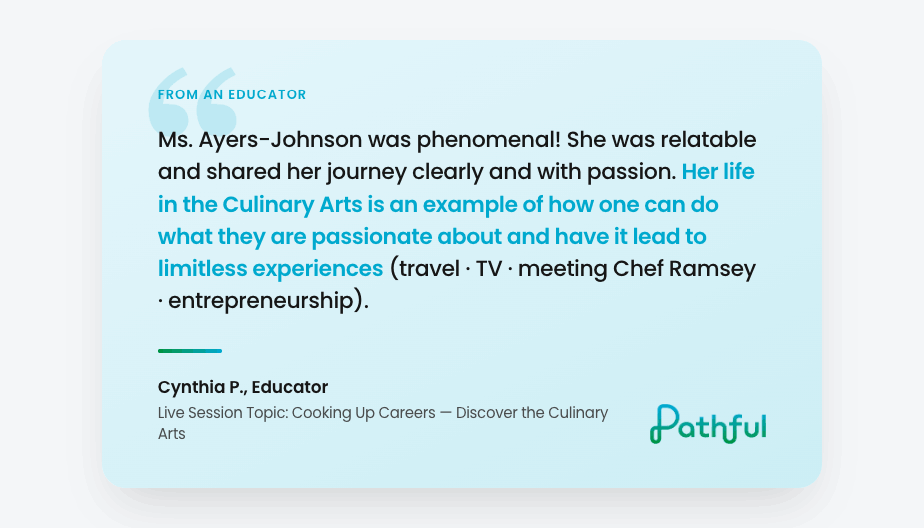
This is not an argument against AI. It is a clarification of roles. AI can tell a student what a culinary arts professional does. It cannot replicate the moment when Ms. Ayers-Johnson, a real professional with a real story, describes how her passion led her to travel, television appearances, meeting Chef Ramsey, and entrepreneurship, and a student in that session realizes that the life she is describing is one they could actually build. That moment belongs to a human being. It belongs to a volunteer.
That feedback from Educator Cynthia P. captures something no dashboard can measure: a student's sense of what is possible expanded. The professional who led that session did not just deliver information. She delivered a version of the future that a student could now picture themselves in. That is career readiness.
Research from Pathful's WBL Management System Playbook reinforces the downstream return on moments like this. Among students who participate in work-based learning, 92% report gaining valuable experience that directly helps them in the workplace. Among WBL participants, 68% receive job offers after completion. Students who build professional networks during their school years have 85% higher career placement rates and report greater career satisfaction five years post-graduation. Every Pathful volunteer contributed to those outcomes this year.
Three Ways Pathful Volunteers Show Up: Industry-Led Projects, Pathful Presents, and Live Virtual Sessions
Pathful designed its volunteer ecosystem around one core truth: professionals have different schedules, expertise, and comfort levels with student engagement. The result is three distinct formats, each offering students a different type of authentic interaction that software cannot simulate.
VOLUNTEER OPPORTUNITY SPOTLIGHT: Industry-Led Projects
Industry-Led Projects give professionals the opportunity to bring a real-world challenge from their own organization into a CTE or work-based learning classroom. Students work in teams to research, analyze, and present solutions, while the volunteer serves as the industry client, mentor, and evaluator. The experience mirrors the project-based workflow students will encounter in their first professional role. ILPs address one of the most critical gaps in traditional career education: giving students a live audience, authentic stakes, and the experience of presenting to someone who actually works in the field they are exploring. No AI can simulate the feedback loop that happens when a real engineer tells a student their analysis missed a key variable, or when a marketing director lights up because a student's campaign concept is genuinely creative.
VOLUNTEER OPPORTUNITY SPOTLIGHT: Pathful Presents
Pathful Presents is Pathful's signature professional presentation format, connecting industry volunteers with classrooms for structured, curriculum-aligned career conversations. Professionals share their career journeys, daily responsibilities, and honest reflections on their industry in a format designed to be engaging, age-appropriate, and directly connected to what students are studying. Research from the American School Counselor Association found that 85% of middle school students are interested in learning what education or experience is needed for the careers they find appealing. Pathful Presents meets that curiosity directly, replacing an abstract career description with a human story that a student can actually hold onto.
VOLUNTEER OPPORTUNITY SPOTLIGHT: Live Virtual Sessions
Pathful's live virtual session format allows professionals to engage directly with students through facilitated, real-time conversations, question-and-answer panels, virtual workplace tours, mock informational interviews, and career exploration discussions. The spontaneous, responsive quality of live interaction is what makes these sessions so powerful. Pathful's WBL playbook identifies informational interviews as a cornerstone of the career exploration stage, defined as a one-on-one conversation where students learn from someone working in a field of interest. When that conversation happens live, students are not passive consumers. They are practicing the professional communication skills that employers consistently rank as critical, in a low-stakes, supportive environment.
In Their Words: The Moments Behind the Numbers
The Pathful Professional Volunteer Impact Statement says it best: the numbers are big. The moments are bigger. Behind every session is a conversation that stuck, for the educator who invited a volunteer in and for the student who left thinking differently about what is possible. Three voices from this year's statement say more than any statistic can.
.png)
Dresden's feedback captures something that goes beyond content delivery. He did not just learn about video game design. He was treated as a peer. He was seen as a future professional rather than a student filling a seat. That shift in identity, from observer to potential practitioner, is precisely what the research on career development identifies as the turning point in a young person's relationship to their future. It is not something a chatbot can produce.
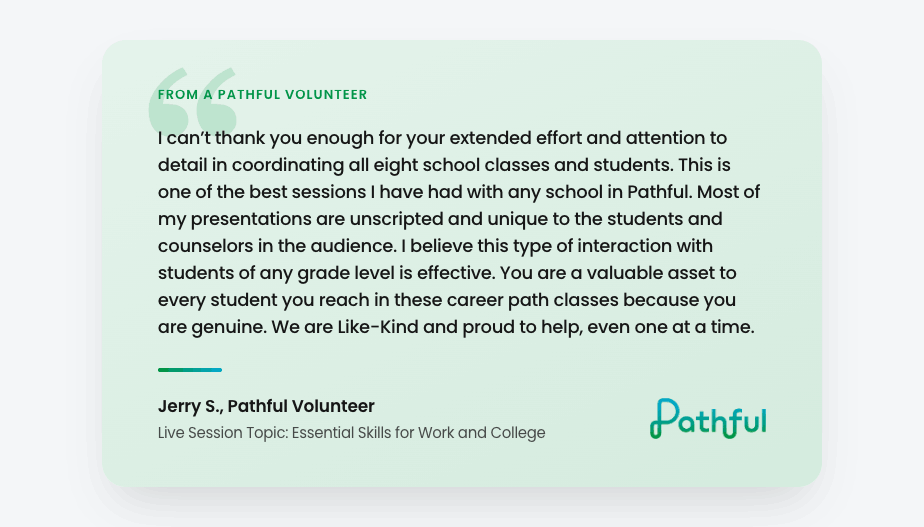
Volunteer Jerry S.'s message to educator Jeremy is a reminder that the relationship built through Pathful's platform runs in all directions. Students benefit. Educators are supported and energized. And volunteers themselves find meaning in the work. The phrase "even one at a time" is the philosophy behind every Pathful session: that a single conversation, with a single student, in a single school, is worth showing up for. Multiply that by 28,458 students and the scale of what this community accomplished in 2025-2026 comes into focus.
The Equity Case: Professional Volunteers Level the Field
There is an equity dimension to this work that deserves direct acknowledgment. Career readiness has historically been distributed unevenly. Students whose parents work in medicine, technology, finance, or law arrive at high school with built-in professional networks. They have dinner-table career conversations, family connections to internships, and access to working professionals that other students have to hope a counselor can simulate. Pathful's volunteer ecosystem exists, in part, to disrupt that structural advantage.
Research cited in Pathful's Why Career Readiness and Development Matters white paper found that over 83% of employers view collaboration between schools and businesses as essential to workforce development, yet fewer than 20% report frequent interaction with K-12 schools. Professional volunteers who engage through Pathful are filling that gap directly. They are the industry connection that a first-generation student in a rural district would otherwise never have access to. They are the professional who treats a teenager as a future colleague, because that is exactly what that teenager is.
The 2023 SkillsUSA Advantage report found that structured CTE participation and CTSO membership produce equity gains across demographic groups. Girls, students of color, and students at low-income schools all showed improved outcomes. What drives those gains is not curriculum alone. It is human connection embedded in the curriculum. The professional who shows up for a Pathful session is not just delivering career information. They are extending their network, their credibility, and their time to a student who has not yet earned the access that professional networks typically require. That is an act of equity, done one session at a time.
Thank You, Pathful Professionals. Now Let's Keep Going.
To every professional who led an Industry-Led Project, delivered a Pathful Presents session, or showed up live for students this year: the numbers in this Brag Sheet belong to you. 28,458 students had a clearer view of what was possible because you gave your time. 1,549 sessions happened because you said yes to a scheduling request. 3,444 hours of authentic connection accumulated because you believed that students were worth the investment.
The research says structured career development interventions reduce career decision-making difficulties by 50%. Students who build professional networks during school have 85% higher career placement rates. Work-based learning participants are 68 percent more likely to receive job offers after completion. Those numbers are not abstract. They describe real students in real classrooms who had real conversations with real professionals, and whose futures are different because of what happened in those sessions.
If you are a professional who has not yet explored Pathful's volunteer opportunities, this is the invitation. Industry-Led Projects, Pathful Presents, and live virtual sessions are open to professionals across every career cluster, and there is no minimum commitment required to make a meaningful difference. If you are already a Pathful volunteer, share the Brag Sheet. Let your network know what this community accomplished. And help us reach even more students in the year ahead.
Because the algorithm cannot shake a student's hand. It cannot look them in the eye and say, "This career path is hard, and it is worth it." It cannot become the person they picture when they imagine their future. Only you can do that.
.png)
Sources
Lindsay, J., Hughes, K., Dougherty, S. M., Reese, K., & Joshi, M. (2024). What We Know About the Impact of Career and Technical Education: A Systematic Review of the Research. CTE Research Network.
Utah State Board of Education. (2024). CTE at a Glance: Wasatch Front South Region, 2023-2024.
Student Research Foundation. (2023). The SkillsUSA Advantage. SkillsUSA.
Association for Career and Technical Education (ACTE). (2022). CTE Works! Statistics Compilation.
Riipen. (2023). Student Success with Access to Workplace-Ready Skills and Employment.
Higher Ed Dive. (n.d.). Work-Based Learning Expectations and Experiences Among College Students.
XQ Super School. (n.d.). High School and the Future of Work.
Jobready360 by Pathful. (2025). The WBL Management System Playbook, v1.0.9. Pathful.
Pathful. (2026). New CTE Pathway Launch Playbook: A 12-Month Implementation Guide. Pathful.
Pathful. (2026). The Complete Perkins V Application Toolkit. Pathful.
Education to Workforce Organization. (n.d.). Indicator: Participation in Work-Based Learning.