
7 counselor-friendly career readiness platform features
A practical evaluation checklist for comparing career readiness platforms by the features that genuinely support counselors, not just administrators.
Choosing a career readiness platform is one of the higher-stakes technology decisions a district makes, and school counselors are the people who live with that choice every day. The right platform extends a counselor's reach across a caseload that, according to the American School Counselor Association, now averages 372 students per counselor nationally, well above the recommended 250 to 1 ratio. The wrong platform simply adds logins, clicks, and reports without helping a single undecided student find direction.
Pathful is the nation's leading Career Readiness and Development (CRD) company, partnering with counselors and district leaders across thousands of schools nationwide. This guide serves as a practical evaluation checklist so you can compare career readiness platforms by the features that genuinely support counselors, whether you are renewing a current tool or reviewing other options in the marketplace.
After 25 years working in and alongside CTE programs, I have seen what happens when a school selects a platform that was designed for administrators first and counselors second. Usage drops, students fall through the cracks, and the technology budget goes to waste. The seven features below reflect what actually moves the needle for practitioners.
What is a career readiness platform?
A career readiness platform is software that helps K-12 schools guide students from career awareness through postsecondary and workforce preparation. It typically combines interest and skills assessments, academic and course planning, career exploration, and work-based learning tools in one system, giving counselors a shared place to support every student's path.
Career-connected learning, a term that appears throughout this guide, refers to instruction and experiences that link classroom learning to real careers, such as virtual job shadows, live industry sessions, internships, and mentorship with working professionals. This kind of learning distinguishes a true Career Readiness and Development (CRD) platform from a basic college and career readiness (CCR) tool that focuses primarily on postsecondary planning and application management.
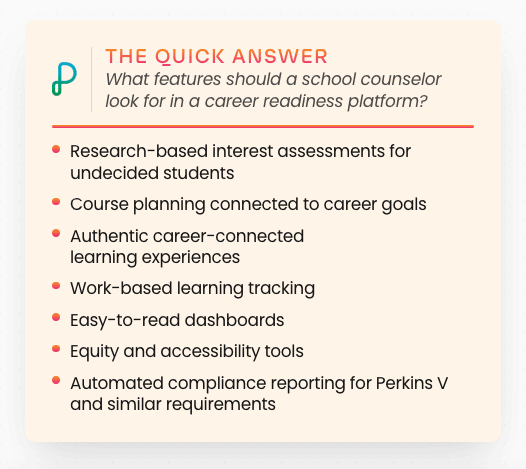
7 features counselors should evaluate
1. Interest and skills assessments that give undecided students a starting point
For the many high school students who feel undecided, a strong career readiness platform starts with quick, research-based interest and aptitude assessments. These tools turn an overwhelming question, what do you want to be, into a short list of pathways a student can actually explore. That first step is often the single most useful thing a counselor can offer a student who walks in without any direction.
According to research cited in Pathful's white paper, Why Career Readiness and Development Matters, 85 percent of middle school students are interested in learning what education or experience is needed for careers they like, yet most high schools provide career experiences to only 10 to 15 percent of students. Strong assessments are the on-ramp to closing that gap. Look for platforms where assessment results connect automatically to career pathways and exploration content, rather than producing a one-time report that collects dust.
This capability maps to the Awareness phase of Pathful's four-phase Career Readiness and Development framework, and it is the feature counselors most frequently credit when they describe a platform that actually changed how students think about their futures.
2. Course planning tied to real career goals
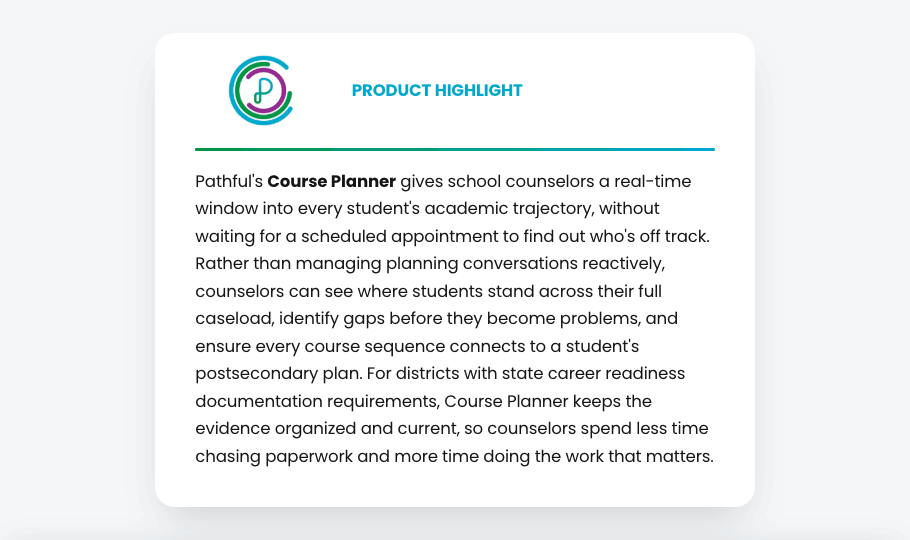
Student course planning works best when it connects directly to a career goal rather than living in a separate scheduling system. Look for a platform that lets students and counselors map multi-year academic plans, see which courses align to a chosen pathway, and adjust as interests change, so that course selection becomes a career decision rather than a calendar exercise.
This matters because the National Center for Education Statistics reports that the majority of public high school graduates complete at least one career and technical education course, and aligning those courses to a coherent pathway is where counselors add the most strategic value. When course planning is siloed from career exploration, students make scheduling decisions without understanding how each class connects to the future they are trying to build.
Counselors serving large caseloads particularly benefit when course planning tools include progress dashboards that surface students who are off-track without requiring manual review of each individual record.
3. Authentic career-connected learning, not just career descriptions
The feature that separates a true Career Readiness and Development platform from a static career database is access to real people and real workplaces. Career-connected learning features such as virtual job shadows, live industry sessions, and recorded professional Q&As let students hear directly from working professionals. That builds a kind of relevance and motivation that text-based career profiles cannot match, and it supports the Exploration phase of career readiness.
Pathful's own research shows that 70 percent of high school seniors expect to have work-based learning experiences, but by the time they graduate only 48 percent report having had them. Immersive, professional content narrows that gap, especially in rural and under-resourced districts where transportation and geography limit in-person opportunities. A platform with a rich library of virtual career content creates equity of access at scale.
When evaluating this feature, ask vendors specifically how content is produced and updated. Pre-recorded videos from 2019 do not reflect today's workforce. Look for platforms that refresh content regularly and connect students to live professionals, not just archived recordings.
4. Work-based learning tracking and management
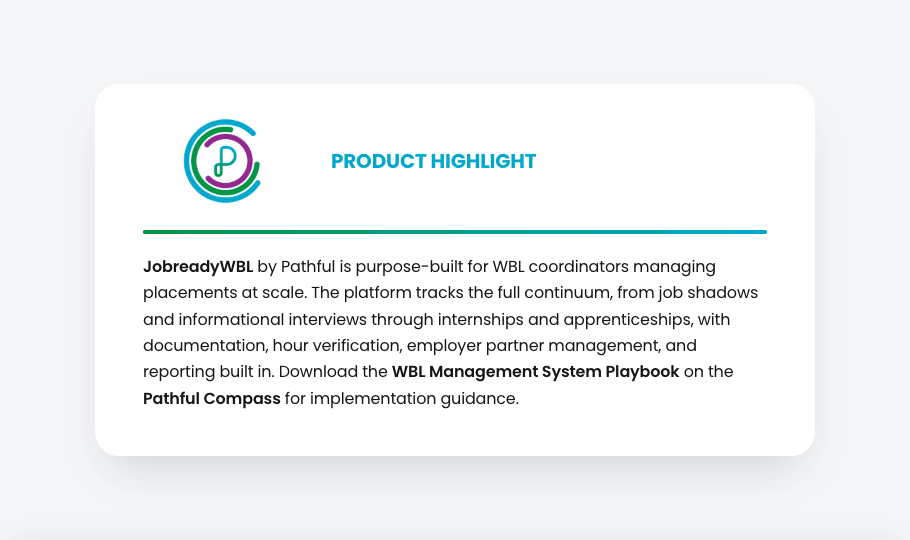
Work-based learning (WBL) is hands-on experience connected to a student's education, including internships, job shadows, apprenticeships, and mentorships. As districts scale these programs, counselors and WBL coordinators need tools that track placements, hours, employer partners, and student reflections in one place. Without WBL management features, career-connected learning becomes an administrative burden that does not scale across a full caseload.
Pathful's WBL Management System Playbook, available on the Pathful Compass, outlines the full spectrum of WBL types from career awareness activities like guest speakers and workplace tours all the way through cooperative education and apprenticeships. Coordinating that continuum across dozens or hundreds of students requires purpose-built management tools, not spreadsheets.
From a Perkins V perspective, performance indicators 5S1 (work-based learning participation) and 5S2 (credential attainment) require documented evidence. Platforms that automate WBL tracking produce that documentation as a byproduct of normal use, rather than forcing coordinators to reconstruct records at reporting time.
5. Counselor dashboards and low-lift workflows
A counselor-friendly platform surfaces who needs attention without extra digging. Dashboards that show plan completion, assessment results, and student activity across an entire caseload let counselors prioritize their limited time. With caseloads averaging well above the recommended 250-to-1 level nationally, workflow efficiency is not a nice-to-have. It is the difference between a platform that gets used daily and one that gets abandoned by October.
When evaluating dashboards, ask how many clicks it takes to identify students who have not completed a career assessment, who have not mapped a four-year plan, or who are missing required WBL documentation. The answer tells you more about a platform's counselor-friendliness than any feature list.
For districts with significant equity commitments, dashboards should also allow filtering by student subgroup so counselors can identify and address gaps in participation before they become performance gaps on accountability measures.
6. Equity and accessibility for every learner
Career Readiness and Development only works if it reaches every student, including English learners, students with disabilities, first-generation students, and those from low-income households. Research from Pathful's white paper shows that only 16 percent of first-generation college students participate in internships, compared to 23 percent of their peers, and they are less likely to receive compensation when they do participate. Platforms that default to in-person-only WBL or require strong family networks to access professional connections structurally disadvantage the students who need support most.
Look for accessibility features such as text-to-speech, multilingual support, and mobile access, along with self-guided pathways that let students explore independently. Virtual career-connected learning content is itself an equity feature: it eliminates geographic and transportation barriers so that a student in a rural district has the same access to a healthcare professional or a software engineer as a student in a major metropolitan area.
Perkins V explicitly requires districts to review progress toward improving access and equity for special populations, including students with disabilities, English learners, economically disadvantaged students, youth in foster care, and students with a parent in active military duty. A platform that logs participation data by subgroup gives counselors and CTE directors the evidence they need to demonstrate equity progress in their Comprehensive Local Needs Assessment.
7. Reporting and compliance that reduce administrative load
Strong reporting features turn required data into a few clicks instead of a spreadsheet marathon. Counselors and CTE directors increasingly need to document outcomes for accountability measures and funding requirements, most notably Perkins V, the federal law that distributes approximately 1.4 billion dollars annually to support CTE programs at the secondary and postsecondary levels.
Perkins V performance indicators that platforms can help districts document include the four-year graduation rate for CTE concentrators (1S1), postsecondary placement rates (3S1), work-based learning participation (5S1), and credential attainment (5S2). A platform that generates compliant reports automatically is not just a convenience, it is a funding protection tool. Districts that cannot document performance risk losing Perkins allocations.
Beyond Perkins V, counselors benefit from reporting that supports ESSA college and career readiness indicators and state-specific individual career and academic plan (ICAP) or individualized graduation plan (IGP) requirements. The best platforms adapt their reporting outputs to your state's specific framework rather than requiring manual translation. Pathful's Perkins V Application Toolkit, available on the Compass, provides additional guidance on meeting Perkins V requirements.
How career readiness platforms compare
Most established platforms cover the basics of assessments and planning, and each brings particular strengths. The right choice depends on which of the seven features above matter most for your students and counselors. Counselors who evaluate platforms primarily on interface design or pricing often discover after implementation that the features they needed most, particularly WBL management and compliance reporting, were not part of the product they selected.
Pathful's distinctive contribution within the K-12 Career Readiness and Development landscape is its four-phase framework, which pairs planning and assessment with live connections to working professionals and comprehensive work-based learning management. Rather than treating career readiness as a scheduling problem to be solved in the guidance office, Pathful embeds career development across a student's entire K-12 journey.
Pathful serves millions of students and adult learners across thousands of schools and districts nationwide. The platform connects K-12 learners with more than 45,000 professionals across 5,000-plus companies through virtual job shadows, live industry sessions, skills assessments, and work-based learning management tools, all organized around the Awareness, Exploration, Preparation, and Placement framework.
Choosing a platform that gives time back to counselors
No single platform is right for every district. But by evaluating career readiness platforms against these seven counselor-friendly features, especially the ones that support undecided students, connect course planning to career goals, and scale career-connected learning, counselors and district leaders can choose a tool that genuinely gives time back to the people students rely on most.
The question to keep in front of every vendor during your evaluation is simple: when a counselor with 372 students on her caseload sits down on a Tuesday morning, what does your platform make easier for her? The answer tells you everything.
To see how Pathful supports counselors, CTE directors, and WBL coordinators across the seven features in this guide, explore the resources available on the Pathful Compass.
Frequently asked questions
What is the difference between a Career Readiness and Development (CRD) platform and a college and career readiness (CCR) tool?
The terms overlap but reflect different philosophies. College and career readiness (CCR) tools focus heavily on postsecondary planning and the college application process. A Career Readiness and Development platform takes a broader, experience-driven view that also includes career exploration, work-based learning, and direct connections to professionals across a student's full K-12 journey. Many districts use both together to address administrative efficiency and genuine career development simultaneously.
How do career readiness platforms help undecided students?
They give undecided students a low-pressure starting point. Interest and aptitude assessments suggest pathways based on a student's own preferences and strengths, and self-guided exploration lets them research those options at their own pace. This turns career planning from an intimidating single question into a series of small, manageable steps.
What is work-based learning (WBL)?
Work-based learning is hands-on career experience connected to a student's education, such as internships, job shadows, apprenticeships, and mentorships. Career readiness platforms with WBL management features help schools coordinate placements, track hours and competencies, and document outcomes, which makes these programs easier to scale across an entire district.
Do career readiness platforms support Perkins V compliance?
Yes, when they include built-in reporting. Perkins V requires districts to track performance indicators including work-based learning participation (5S1) and credential attainment (5S2). Platforms that automate this documentation reduce reporting burden and protect funding. Pathful's Perkins V Application Toolkit, available on the Pathful Compass, provides additional guidance on meeting Perkins V requirements.
Are career readiness platforms only for high schools?
No. While many features are most active in high school, career awareness and exploration can and should begin in elementary and middle school. Strong platforms offer age-appropriate experiences across K-12 so that career development builds gradually rather than starting only in the final years before graduation.
How should a district choose a career readiness platform?
Start with your students' needs and your counselors' workload. Identify which of the seven features in this guide matter most, such as support for undecided students, work-based learning management at scale, or automated Perkins V reporting, then compare platforms against that prioritized list. Involve counselors in the evaluation process, since they will use the tool daily.
Sources
- American School Counselor Association. School Counselor Roles & Ratios.
- National Center for Education Statistics. Career and Technical Education in the United States.
- U.S. Department of Education. Strengthening Career and Technical Education for the 21st Century Act (Perkins V).
- Pathful. Why Career Readiness and Development Matters: Closing the Gap Between Graduate Preparation and Employer Expectations. White Paper, October 2025.
- Pathful. The Complete Perkins V Application Toolkit: A Step-by-Step Guide for CTE Directors.
- Pathful. New CTE Pathway Launch Playbook: A 12-Month Implementation Guide.
- Jobready360 by Pathful. The WBL Management System Playbook. v1.0.9, September 2025.
- Advance CTE. State Policies Impacting CTE.
- Association for Career and Technical Education (ACTE). CTE Research & Policy.
- U.S. Bureau of Labor Statistics. Occupational Outlook Handbook.
- National Association of Colleges and Employers (NACE). Job Outlook Survey.
- Association of American Colleges and Universities (AAC&U). The Career-Ready Graduate: What Employers Say about the Difference College Makes. May 2023.
- Higher Ed Dive. Work-Based Learning Expectations vs. Reality.
- Strada Education Network. Understanding Undergraduates' Career Preparation Experiences. December 2021.
- XQ Super School. High School and the Future of Work.
- ResearchGate. The Effectiveness of Career Guidance and Counseling Services in Secondary Schools. April 2025.
- Education to Workforce Organization. Indicator: Participation in Work-Based Learning.
- American School Counselor Association. ASCA Student Standards: Mindsets and Behaviors for Student Success.
- ScienceDirect. Career Development and Educational Engagement.
- Riipen. Student Success with Access to Workplace-Ready Skills and Employment. June 2023.
- The Prichard Committee. Kentucky Employer and Industry Survey Analysis and Report. December 2024.
- SchooLinks. Sarasota County Schools: Transforming Work-Based Learning with SchooLinks and Pathful.

Keep reading.
What is Perkins V reporting for school districts?
The federal performance indicators, who has to report, and how career readiness platforms centralize the data compliance requires.
Connecting career exploration in high schools to student ILPs
How school counselors and CTE leaders can turn exploration into a living, documented roadmap for every student.
From guidance office to career path
How career readiness platforms give counselors scalable tools for undecided students.
Ready to make career readiness more meaningful?
Let's talk about how Pathful can support your students and meet your goals.