
Connecting career exploration in high schools to student ILPs
How school counselors and CTE leaders can turn exploration into a living, documented roadmap for every student.
I have spent more than 25 years in Career and Technical Education, first as a teacher, then as a principal, and eventually as a district CTE director. In all of those years, the question I heard most often from counselors and CTE educators was some version of this: how do we make the ILP feel like something students actually use?
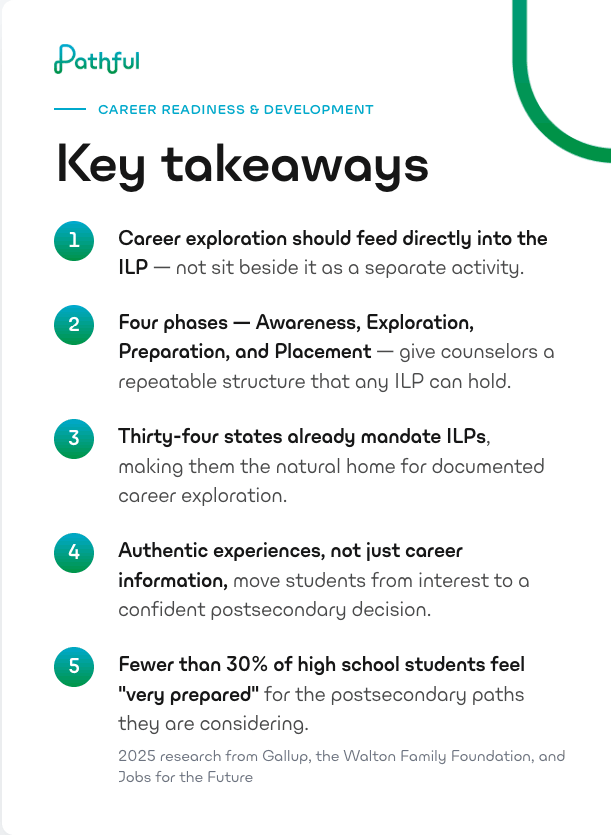
The honest answer I kept coming back to is that the ILP becomes meaningful the moment career exploration feeds into it. Not beside it. Not tracked in a separate binder. Into it, as living documentation that grows with the student. That is the shift that transforms a compliance form into a roadmap, and it is exactly what Pathful was built to help schools accomplish.
This guide is written for high school counselors, WBL coordinators, and district career readiness leaders who want to connect exploration activities to individualized learning plans in a structured, measurable, and authentic way. We will walk through what that connection looks like at each grade level, what the research says about why it matters, and how the right tools can make it practical at scale.
What is career exploration in high schools?
Career exploration in high schools is the structured process of helping students discover careers, industries, and pathways that match their interests and strengths. It includes interest assessments, virtual job shadows, live industry sessions, and work-based learning, giving students real exposure to careers that exist before they commit to a postsecondary path.
The distinction between exploration as an event and exploration as a process is important. A single career fair introduces students to possibilities, but it does not produce the career identity that leads to informed decision-making. That identity develops over time, through repeated exposure to professionals, industries, and workplace realities that sharpen and confirm a student's sense of direction. Research cited in Pathful's white paper Why Career Readiness and Development Matters shows that students who frequently experience integrated career development activities see a 23% improvement in career and workforce outcomes compared to peers with limited exposure.
When exploration is treated as a continuous process rather than an annual event, it also produces something counselors and administrators can document: evidence of growth. That documentation is exactly what the ILP is designed to hold.
What are Individualized Learning Plans (ILPs)?
An individualized learning plan (ILP), also called an Individual Career and Academic Plan (ICAP) or an academic and career plan, is a personalized, multi-year plan that documents a student's goals, course selections, and career interests. Developed by the student alongside counselors and family, an ILP keeps academic decisions aligned with postsecondary and career goals throughout high school.
ILPs are not a niche practice. According to the U.S. Department of Education's Regional Educational Laboratory program, 34 states mandate ILPs for all students, and an additional 10 states strongly encourage their use. For most high school counseling teams, the question is not whether to use an ILP, but how to make it meaningful year after year.
The challenge counselors describe most often is that the ILP becomes a static document, updated once a year and then filed away until the next review cycle. That pattern is almost always a symptom of the same underlying problem: the exploration activities that could bring the plan to life are tracked in a separate system, or not tracked at all. When a student completes a virtual job shadow in October and that experience is never recorded in the ILP, the plan stays empty even as the student's understanding of their future grows.
Why connect career exploration to ILPs?
Connecting career exploration in high schools to ILPs turns a compliance document into a living roadmap. When exploration activities feed directly into the plan, students choose courses with purpose, counselors can see real engagement, and the plan reflects genuine interests rather than guesses. The result is stronger career readiness and fewer students who graduate without direction.
The need is well documented. In a 2025 study from Gallup, the Walton Family Foundation, and Jobs for the Future, fewer than 30% of high school students said they feel "very prepared" to pursue the postsecondary paths they are considering. The same research found that roughly half of students have never held a job or internship, and more than a third have never visited a college campus, the exact experiences students say help them most.
The employer side of that equation is equally stark. Pathful's white paper on Career Readiness and Development reports that only 12% of employers express strong confidence in high school graduate preparedness, and less than 10% rate graduates as well-prepared in professionalism, critical thinking, and communication. The gap between how ready students feel and how ready employers find them cannot be closed by a planning document alone. It requires experiences that build genuine competencies, documented in a way that tells a coherent story of a student's growth.
Meanwhile, the labor market continues to send a clear signal. The U.S. Bureau of Labor Statistics reported 7.6 million job openings in April 2026, with open positions outnumbering unemployed workers. Students who explore early and document that exploration in an ILP are far better positioned to step into careers that actually exist.
Fewer than 30% of high school students feel "very prepared" for the postsecondary paths they are considering.
— Gallup, Walton Family Foundation, and Jobs for the Future (2025)
How to connect career exploration to high school ILPs: the four-phase framework
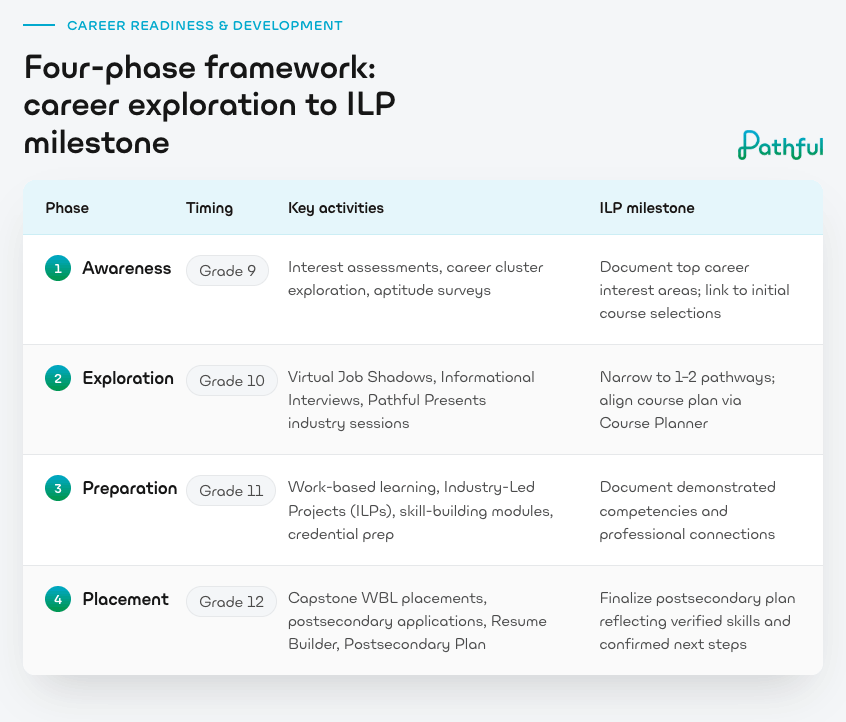
The most practical structure for connecting exploration to ILPs is a four-phase framework that maps activities to planning milestones across all four years of high school. Each phase corresponds to a developmental stage in a student's career identity, and each produces documentation that belongs in the ILP.
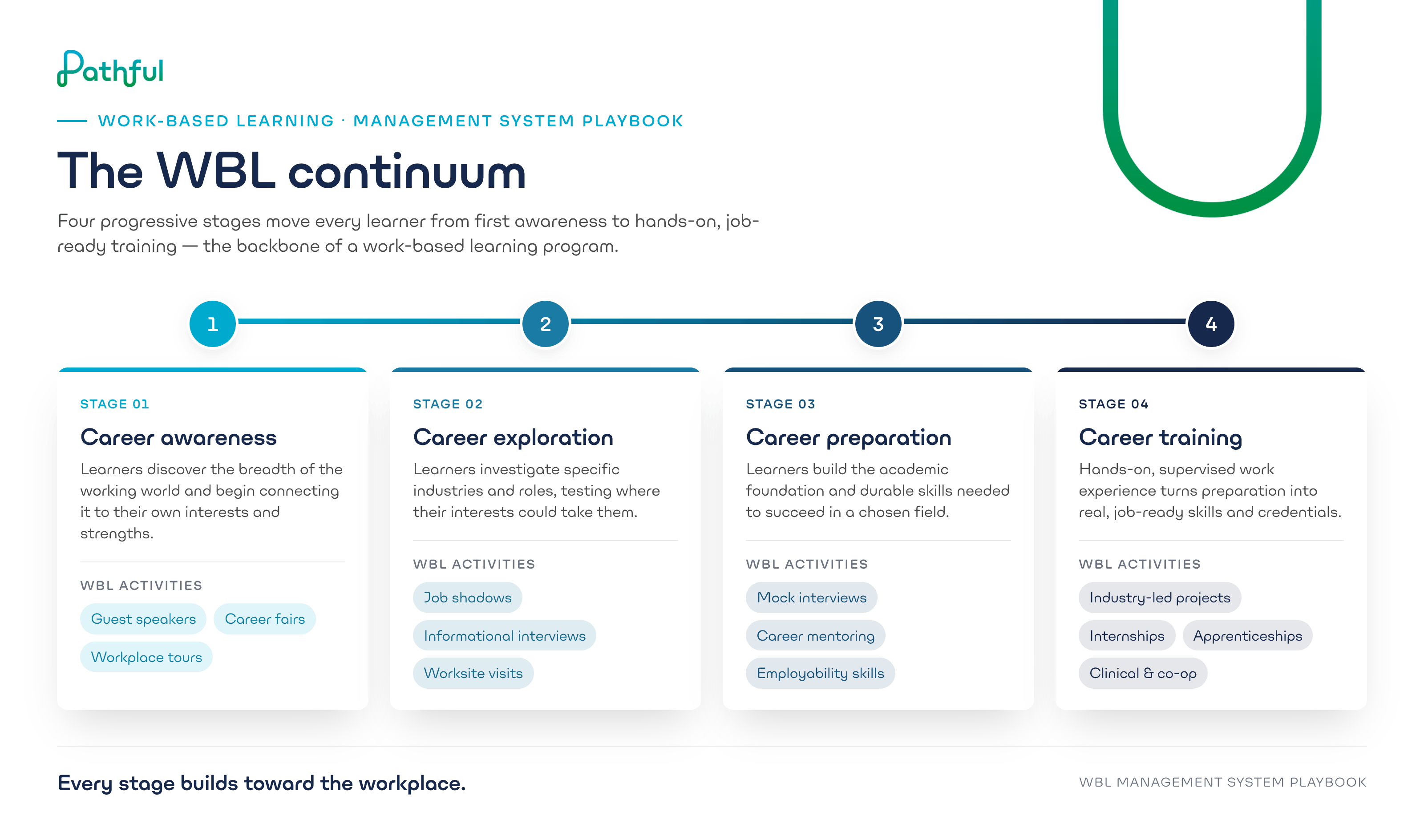
This framework aligns directly with the Career Readiness and Development approach Pathful has built its platform around, and it mirrors the progression described in Pathful's WBL Management System Playbook, which outlines career awareness, career exploration, career preparation, and career training as a continuum from initial exposure to real workplace application.
Phase 1: Awareness (Grade 9) — spark initial interest
The Awareness phase is where career exploration begins. In ninth grade, most students have broad curiosity and limited framework for thinking about careers. The goal of this phase is to spark genuine interest across a wide range of possibilities, so that the student's ILP begins with an informed starting point rather than a default choice.
Interest and aptitude assessments are the natural entry point. When a student completes an assessment and discovers that her strengths align with health science or that his curiosity about technology connects to real occupations, the ILP gains a foundation. That foundation — top interest areas and their connection to career clusters and course options — should be recorded in the plan immediately, not revisited at the end of the year.
The Awareness phase does not require extensive employer engagement. Guest speakers, career fairs, and virtual career tours are low-intensity activities that introduce students to the world of work without requiring deep logistical infrastructure. Pathful's library of Virtual Job Shadow content, with access to professionals across more than 5,000 companies, gives counselors and teachers a way to deliver this exposure efficiently at scale, even when in-person employer visits are limited.
Phase 2: Exploration (Grade 10) — test interests against reality
By tenth grade, students have initial interest areas on record. The Exploration phase is where those interests get tested against real-world exposure. This is the stage where information about a career gives way to actual observation, and where broad curiosity narrows into genuine pathway direction.
Virtual Job Shadows, Informational Interviews, and Pathful Presents industry sessions are the core tools of this phase. A student who completes a virtual job shadow in engineering and an informational interview with a local healthcare professional in the same semester has produced two concrete, documentable experiences. Both should be recorded in the ILP as exploration milestones, and both should inform the course selection conversation that follows.
This is also the phase where Pathful's Course Planner becomes essential. Once a student has narrowed to one or two pathways of genuine interest, the Course Planner helps counselors and students align the remaining years of high school to support those directions. Course selection recorded in the ILP stops being an administrative task and starts being a strategic decision.
Phase 3: Preparation (Grade 11) — build skills and connections
The Preparation phase shifts from exploration to development. Eleventh grade students who have documented two years of career awareness and pathway exploration are ready to begin building the skills and professional connections that will make their postsecondary choices meaningful rather than aspirational.
Work-based learning is the central mechanism of this phase. Whether through internships, mentorships, or school-based enterprises, students in the Preparation phase are doing work, not just observing it. Pathful's JobreadyWBL platform gives WBL coordinators the tools to manage placements, track compliance, document hours, and record the competencies students demonstrate at each worksite. Those documented competencies belong in the ILP as evidence of real skill development.
Industry-Led Projects are another powerful Preparation-phase tool. When students complete a project designed and reviewed by industry professionals, the outcome is both a skill demonstration and a professional connection. Both are ILP-worthy milestones that tell a more complete story than a course grade alone.
Perkins V performance indicators 5S1 and 5S2 (WBL participation and credential attainment) are directly served by what happens in the Preparation phase. Districts seeking to strengthen their Perkins applications, as outlined in Pathful's Perkins V Application Toolkit, will find that a well-documented Preparation phase produces exactly the program quality evidence the Comprehensive Local Needs Assessment requires.
Phase 4: Placement (Grade 12) — launch with confidence
The Placement phase is where the ILP closes the loop. A twelfth-grade student whose plan reflects three years of documented exploration, course alignment, work-based learning, and skill development is not guessing at a postsecondary direction. She has evidence of what she is good at, connections to professionals in her field, and a plan that reflects real experience.
Capstone experiences, postsecondary applications, Resume Builder activities, and a finalized Postsecondary Plan are the outputs of this phase. Pathful's Lifestyle Calculator helps students connect their career interests to real financial expectations, grounding the postsecondary decision in practical reality rather than aspiration alone. When the ILP is updated to reflect verified capabilities and a confirmed next step, it has fulfilled its purpose.
Career Readiness and Development vs. traditional CCR: what is the difference?
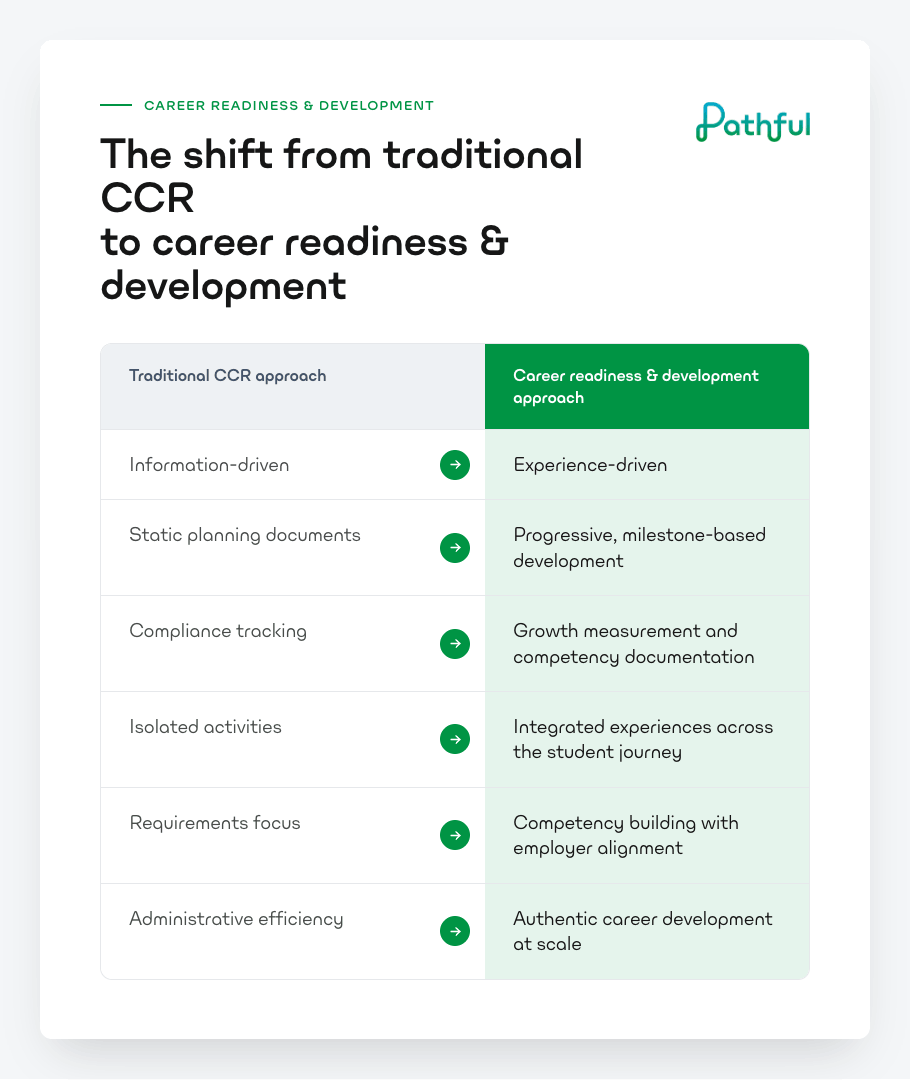
College and Career Readiness (CCR) platforms focus on planning, documentation, and compliance. Career Readiness and Development (CRD) builds on that foundation by adding authentic experiences, progressive skill development, and professional connections. The two are complementary: CCR provides the planning structure, while CRD fills that structure with the experiences that make a plan real.
This is the distinction Pathful was built to address. As Pathful's white paper on Career Readiness and Development explains, CCR platforms excel at administrative efficiency, compliance tracking, and college application management, but they often lack the comprehensive career development infrastructure that prepares students for the workforce rather than simply documenting that preparation occurred.
The goal is not to replace your existing college and career readiness platform, but to enrich it. A strong ILP is the place where both come together, and a strong CRD platform is what gives counselors the tools to make that happen.
How Pathful supports career exploration within ILPs
Pathful is a Career Readiness and Development company serving millions of students and adult learners across thousands of schools and districts nationwide. The Pathful CRD platform connects learners with professionals across more than 5,000 companies through Virtual Job Shadows, live industry sessions, Informational Interviews, skills assessments, and work-based learning management tools.
Because each of those experiences maps to a phase of the student journey, counselors can pull exploration directly into the ILP rather than tracking it separately. Pathful's Course Planner supports the academic and course-planning side of the plan, while career pathways connect interest to skill to placement within a single platform.
For WBL coordinators managing employer partnerships and student placements, JobreadyWBL provides centralized documentation, compliance tracking, and outcome reporting that turns every work-based learning experience into an ILP milestone rather than an isolated activity. The WBL Management System Playbook, available on the Pathful Compass, walks coordinators through implementation from advisory committee formation through Year 1 operation.
For districts building or expanding CTE pathways, Pathful's New CTE Pathway Launch Playbook provides a 12-month roadmap that aligns employer partnerships, curriculum mapping, and student recruitment with the career development activities that feed the ILP. And for CTE directors navigating Perkins V applications, the Pathful Perkins V Application Toolkit connects CLNA findings directly to the program quality indicators that a well-documented four-phase ILP framework supports.
Frequently asked questions
At what grade should career exploration in high schools begin?
Career exploration ideally begins in grade 9, or earlier, with interest and aptitude assessments during the Awareness phase. Starting early gives students time to test interests through the Exploration and Preparation phases, so their ILP reflects informed choices well before senior-year decisions arrive. Research shows that a progressive approach starting in middle school produces superior postsecondary outcomes by allowing students to build career identity gradually over multiple years.
How do ILPs support college and career readiness?
ILPs support college and career readiness by documenting goals, course plans, and career interests in one place. When exploration activities feed the plan, students select courses with purpose and counselors can monitor progress toward postsecondary goals across all four years of high school. The ILP becomes the connective tissue between what a student discovers about careers and the academic decisions that should follow from those discoveries.
What career exploration activities work best inside an ILP?
Interest assessments, virtual job shadows, live industry sessions, informational interviews, and work-based learning all integrate well into an ILP. The most effective activities are authentic experiences that let students test an interest, then capture the outcome as a documented milestone within the plan. Pathful's four-phase framework provides a structure for choosing the right activity type at each grade level.
Who is responsible for connecting career exploration to ILPs?
High school counselors typically lead the process, supported by district career readiness leaders, CTE staff, and families. Shared tools help because they let everyone view the same plan and ensure exploration activities are recorded as ILP milestones rather than lost in separate systems. Pathful CRD is designed to support this shared responsibility across counselors, WBL coordinators, and CTE teachers within a single platform.
How is student career planning different from career exploration?
Career exploration is the discovery process of learning what careers exist and which fit a student. Student career planning is the act of turning those discoveries into concrete academic and postsecondary decisions. An ILP is where exploration becomes planning, connecting the two into a single, evolving roadmap that grows with the student from ninth grade through graduation.
How does work-based learning connect to ILPs under Perkins V?
Under Perkins V, performance indicators 5S1 and 5S2 measure WBL participation and credential attainment as core program quality metrics. When work-based learning experiences are documented in the ILP as competency milestones, districts create the kind of verifiable evidence of student development that strengthens both program quality ratings and CLNA findings. Pathful's Perkins V Application Toolkit, available on the Compass, provides templates for connecting CLNA analysis to the student-level documentation that WBL produces.
Bringing it together
When career exploration in high schools is woven into the individualized learning plan, the plan stops being a form to complete and becomes a roadmap students actually use. That is the heart of Career Readiness and Development: preparing students for careers that exist, with the skills employers need, through authentic experiences and meaningful connections documented every step of the way.
The four-phase framework gives counselors, CTE directors, and WBL coordinators a shared structure for making that happen. The Awareness phase sparks interest and gives the ILP a starting point. The Exploration phase tests those interests against real-world exposure and narrows the pathway. The Preparation phase builds the skills and professional connections that make a postsecondary choice meaningful. And the Placement phase closes the loop, transforming a plan filled with genuine experience into a confident launch.
Pathful was built to support each of these phases within a single student journey, so that no discovery gets lost between systems and no milestone fails to become part of the story a student can tell about herself when she walks across the graduation stage.
For counselors ready to take the next step, the resources referenced throughout this post — the WBL Management System Playbook, the New CTE Pathway Launch Playbook, and the Perkins V Application Toolkit — are all available on the Pathful Compass. And if you want to see how Pathful CRD connects exploration to ILPs in your specific district context, our team is ready to show you.
Sources
- Individual Learning Plans: Students Creating Their Pathways to Postsecondary Success. U.S. Department of Education, Institute of Education Sciences (REL Southwest).
- Gallup, Walton Family Foundation, and Jobs for the Future. Voices of Gen Z: Most High Schoolers Feel Unprepared for Life After Graduation. 2025.
- U.S. Bureau of Labor Statistics. Job Openings and Labor Turnover Survey (JOLTS), April 2026.
- Pathful. Why Career Readiness and Development Matters: Closing the Gap Between Graduate Preparation and Employer Expectations. October 2025.
- Jobready360 by Pathful. The WBL Management System Playbook. Updated September 2025.
- Pathful. The Complete Perkins V Application Toolkit: A Step-by-Step Guide for CTE Directors. 2026.
- Pathful. The Complete New CTE Pathway Launch Playbook: A 12-Month Implementation Guide. 2026.
- U.S. Department of Education. Strengthening Career and Technical Education for the 21st Century Act (Perkins V).
- Inside Higher Ed. Overconfident Students, Dubious Employers. February 2018.
- ResearchGate. The Effectiveness of Career Guidance and Counseling Services in Secondary Schools. April 2025.
- Association of American Colleges and Universities (AAC&U). The Career-Ready Graduate: What Employers Say About the Difference College Makes. May 2023.
- XQ Institute. High School and the Future of Work.
- Strada Education Network. Understanding Undergraduates' Career Preparation Experiences. December 2021.
- The Prichard Committee. Kentucky Employer and Industry Survey Analysis and Report. December 2024.
- Education to Workforce Organization. Indicator: Participation in Work-Based Learning.
- Office of Career, Technical, and Adult Education (OCTAE). Perkins V Secondary Performance Indicators.
- American School Counselor Association (ASCA). ASCA Student Standards: Mindsets and Behaviors for Student Success.
- Riipen. Student Success with Access to Workplace-Ready Skills and Employment. June 2023.
- U.S. Bureau of Labor Statistics. Employment Situation Summary. 2025.
- SchooLinks. Sarasota County Schools: Transforming Work-Based Learning with SchooLinks and Pathful.
Keep reading.
From guidance office to career path
How career readiness platforms give counselors scalable tools for undecided students.
The complete Perkins V application toolkit
A step-by-step guide for CTE directors — CLNA templates for all five required elements, a budget worksheet, and the mistakes to avoid.
The complete work-based learning partnership builder
Cold outreach templates, internship agreement forms, a workplace mentor guide, and a partnership tracking system for WBL coordinators.
Ready to make career readiness more meaningful?
Let's talk about how Pathful can support your students and meet your goals.