
Mining Your Pathful Profile for College Essay Gold
Help students overcome "narrative paralysis" by turning their Pathful profiles into college essay gold. Learn how to bridge the gap between career exploration and a compelling admissions narrative.
.png)
For many students, the college application process is the first time they are asked to reconcile their past experiences with their future ambitions. When they sit down to write the personal statement or supplemental essays, they often hit a wall of narrative paralysis. We hear it from learners across the country: “I haven’t done anything remarkable,” or “I don’t know how to prove I’m a good fit for this major.”
As educators, we know that these students possess a wealth of unique insights. They simply lack a system for evidence retrieval. We have spent years moving students away from accidental career exploration toward intentional planning. Now, we must help them bridge the final gap: translating that intentionality into a compelling admissions narrative.
If your students have been engaging with Pathful, they are not starting from a blank page. They are sitting on a gold mine of personal data. By helping students look at their profiles through a critical lens, we can show them how to find the specific evidence that turns a generic essay into a professional manifesto.
The Evolution of Interest: Beyond the Initial Assessment
Admissions officers are less interested in a student’s final destination than they are in the intellectual curiosity that got them there. A student who simply says they want to study Engineering is common. A student who can articulate the shift from an interest in Artistic design to Investigative problem solving is memorable.
To help students find this story, have them revisit their Assessment Results. By comparing their initial Interest or Personality Assessment results from middle school or early high school to their most recent ones, they can identify a clear trajectory of change or growth. This shift often serves as the inciting incident of a great essay. A specific Virtual Job Shadow video might have sparked a change in direction, or a Career Journal entry from sophomore year may have captured a moment of realization they had since forgotten. These raw, unedited reflections provide the authentic, in-the-moment voice that admissions readers crave.
Competency-Based Storytelling: Leveraging FlexLesson Reflections
Common App prompts frequently ask students to describe a time they faced a challenge or worked toward a goal. Without a record, students often default to generic sports metaphors. Pathful allows them to ground these stories in competency-based evidence by looking at their progress in FlexLessons.
If a student completed a unit on Grit or Time Management, they have already engaged in self-reflection exercises within the platform. Reviewing their responses to the open-ended prompts in these lessons provides them with pre-written kernels of their own philosophy on work and perseverance. You can guide this by asking: "Look back at the Professional Communication lesson you completed last spring. What was the specific communication barrier you identified then? How have you intentionally worked to bridge that gap in your current internship or club leadership role?"
Professional Authenticity: Mining Work-Based Learning Logs
Work-Based Learning (WBL) is a powerful source of essay material that often goes untapped. When students participate in internships, job shadows, or clinical rotations, the details often blur by the time senior year arrives. If they have been logging these experiences in Pathful’s Experience Tracker, they have a chronological record of their professional development.
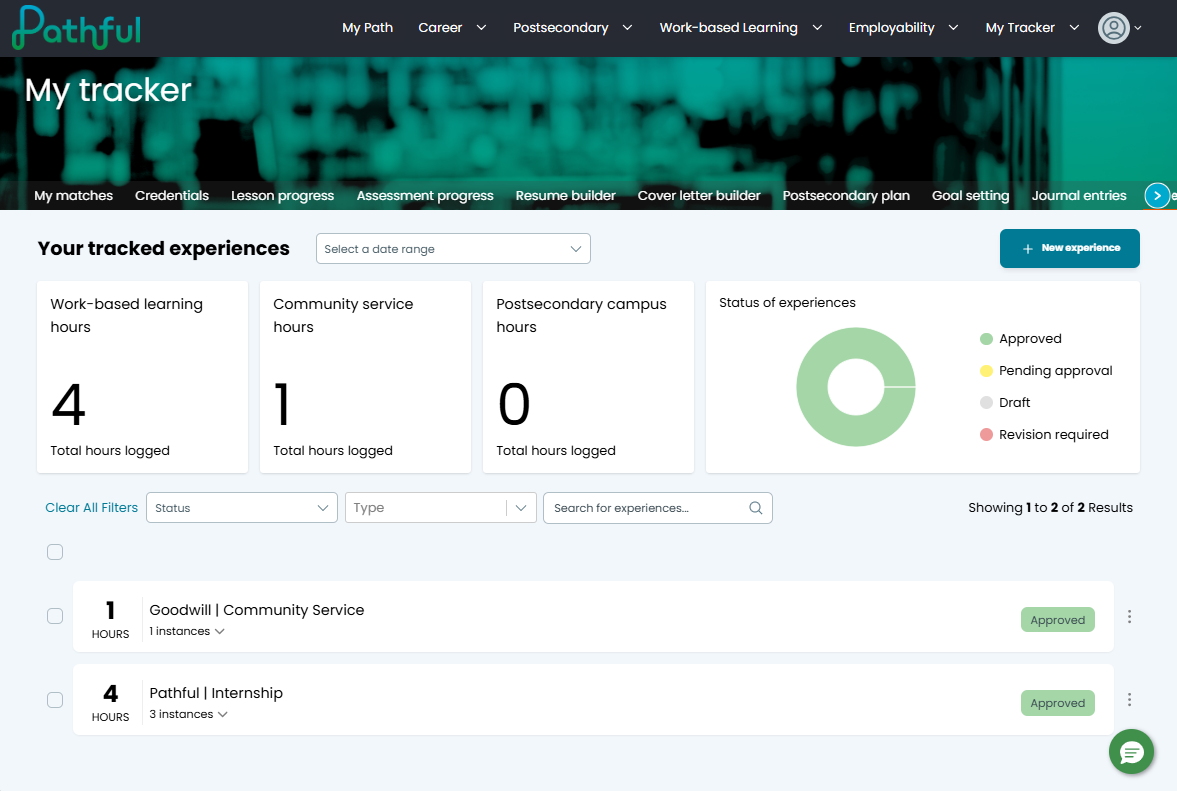
Encourage students to review their Experience Tracker history. These entries contain sensory details, like the specific software they learned, a difficult interaction with a supervisor they navigated, or a project that failed, that make an essay feel lived-in. Instead of claiming they have leadership skills, a student can point to a specific log entry where they managed a task during a volunteer event. This moves the essay from a series of claims to a series of proofs.
Institutional Alignment: Using Comparative Data for Why Us Essays
The "Why Us?" essay is often the most difficult for students because it requires them to prove they understand the specific culture of a college. Pathful’s School Comparison Tool and School Profiles allow students to move beyond the marketing fluff of a brochure and speak to a school’s actual environment and financial landscape.
Encourage students to pull a Side-by-Side Comparison of their top schools. By referencing specific data points like Tuition and Fees, Financial Aid, Undergraduate Admissions, and Population, a student can make an evidence-based case for their choice. For example, a student might write: "My Personality Assessment confirmed that I thrive in collaborative, high-engagement environments. With a Student-to-Faculty ratio of 12:1 and a total Undergraduate Population that mirrors the small-group settings where I excel, your institution offers the specific academic ecosystem I am seeking."
Students can also look at the labor market information within their favorited Career Profiles to bridge the gap between their degree and their future. A student applying for a Cybersecurity major can use the Growth and Outlook data they found in Pathful to prove they are entering a high-demand field with a clear understanding of the regional economic landscape.
Facilitating the Family Conversation: The Profile as a Bridge
Postsecondary planning is rarely a solo journey. For many students, the greatest challenge is not writing the essay, but justifying their choices to their families. We can help students use their Pathful profile to facilitate these often difficult home conversations.
By walking a parent through their Favorited schools and the associated financial aid data, students move from "I think I want to go here" to "Here is the data-backed reason why this school is a viable option for our family." This transparency builds trust and allows families to see the intentionality behind the student’s choices. When a student can show their family the connection between their Assessment results and the long-term value of a specific major, the application process becomes a shared mission rather than a source of household friction.
💡 The Strategy in Action: The 15-Minute Profile Shop
To implement this in your classroom or counseling office, do not wait for the final draft. Host a Profile Shopping session where students spend 15 minutes finding three Favorited careers, one Assessment result, and one WBL reflection that challenged their assumptions. Have them answer one question: "How does this specific piece of data change the way I describe myself to a college?" By the end of the period, they will not just have a list of schools. They will have a roadmap for their personal statement.
.webp)
.png)
.png)


.png)






.png)
.png)

.png)

.png)
.png)



.png)
.png)



.png)
.png)


.png)


.png)
.webp)

.png)
.png)

.png)
.png)
%20(1).png)
.png)
.png)


.png)


.png)



.png)

.png)

.png)
.png)




.png)



.png)

.png)




.png)
.png)



.webp)
.webp)
%20(1)%20(1).webp)
.webp)
.webp)