
Lessons from a Former Counselor: Using Data to Move from Reaction to Impact
Former school counselor Susan Ray shares how the Pathful Planner Counselor Dashboard uses real-time data to help educators move from "reaction mode" to proactive student impact. Learn how to gain visibility into student progress, ensure equity for quiet students, and reclaim your weekly priorities.
.png)
I know what it feels like to walk into school on a Monday morning already behind.
As a school counselor, I carried a caseload of over 350 students. I genuinely wanted to be there for every one of them, but between back-to-back appointments, admin tasks that pulled me away from students, unpredictable crises, and the constant awareness that someone out there needed me, the job felt impossible. Not because I didn’t care enough. There simply weren’t enough hours in the day.
I spent a lot of my career reacting to whoever showed up at my door, whoever a teacher flagged, whoever had a crisis that couldn’t wait. The students who were quietly struggling? The ones who hadn’t asked for help, who hadn’t started a Course Plan, and weren’t on anyone’s radar? I didn’t always get to them in time, or even know they needed my help.
That experience is exactly why, when I joined Pathful as a Product Manager, I knew what I wanted to help build.
The Real Problem Isn’t Time, It’s Visibility
As a school counselor, I wasn’t short on caring. I was short on clarity and lived in reaction mode- deal with the next problem that’s directly in front of me right now.
When every student looks equally “fine” on the surface, it’s nearly impossible to know who’s quietly slipping behind on credits, who hasn’t started thinking about life after graduation, or who needs a nudge before it’s too late to course-correct.
Without data, I defaulted to whoever showed up at the door which meant the students who most needed proactive outreach were the least likely to get it. I lived that reality for years.
Data isn't just about efficiency; it's about equity. It ensures the 'quiet' student (the one who doesn't advocate for themselves or have a parent calling your office) doesn't fall through the cracks just because they didn't make noise. We built the Pathful Planner Counselor Dashboard specifically to help counselors focus their time and energy where it is most needed.
Your Dashboard Tells You Who Needs You First
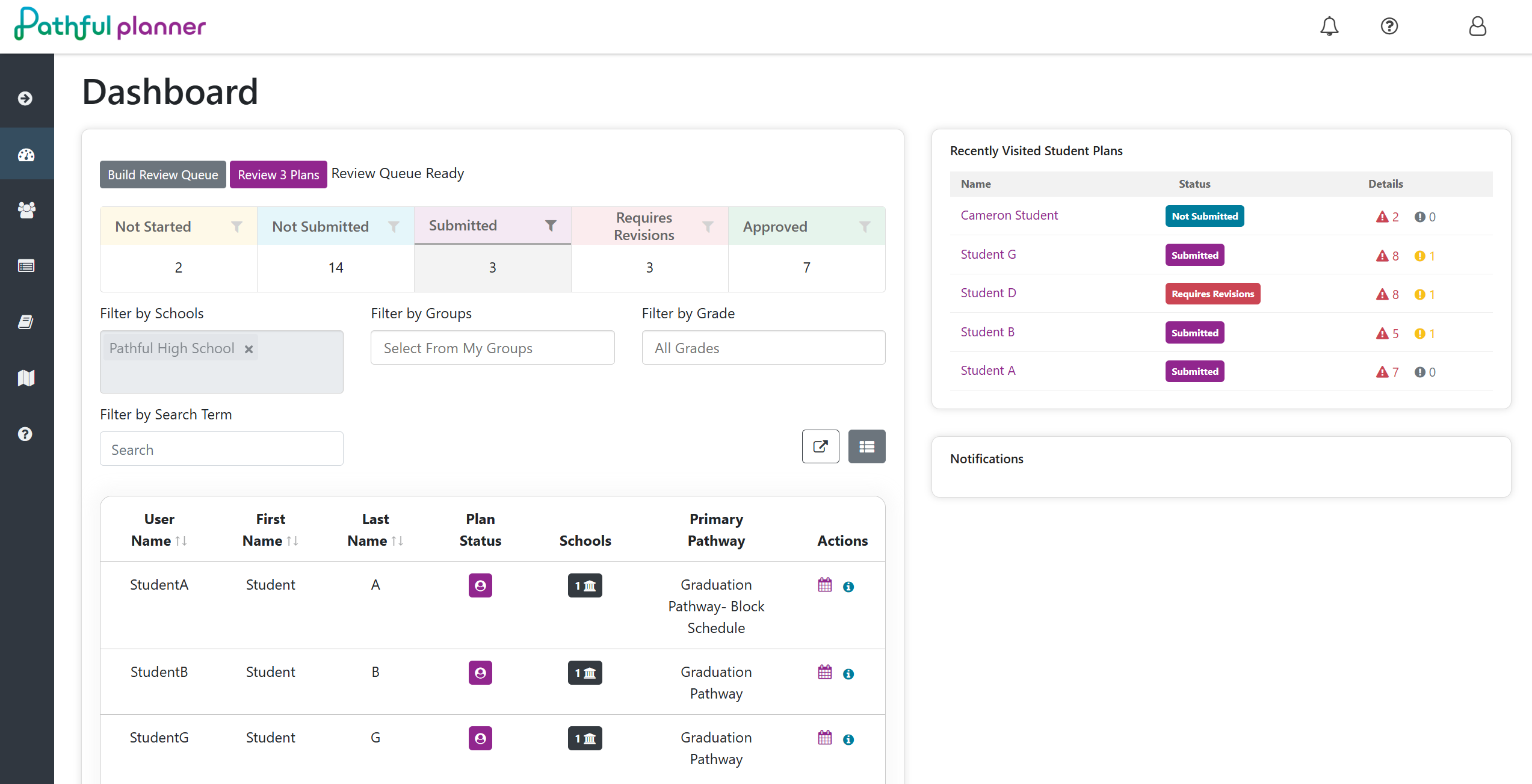
When I sat down with our development team to design the Counselor Dashboard, the question I kept coming back to was: what would have helped me most on a Monday morning?
The answer was simple. I needed to know, at a glance, which students didn’t have a plan yet, and which ones had started but never followed through.
That’s exactly what the Course Planner Dashboard shows you: a real-time breakdown of where every student stands in the course planning process: Not Started, Not Submitted, Submitted, Requires Revisions, and Approved.
Those first two columns? That’s your priority list.
A student who hasn’t started a course plan is a student without a roadmap. A student who’s started but never submitted may be stuck, unsure, or simply waiting for someone to check in. Neither of those students is going to walk into your office and say, “I need help with my plan,” but the dashboard will tell you they exist.
I wish I’d had that when I was a school counselor.
Not Every Student Needs a One-on-One
.png)
One thing I learned the hard way: trying to give every student an individual appointment is a fast road to burnout, and with a large caseload, it’s an impossible task. I quickly learned that not all students needed individual time with me.
When the Planner dashboard shows you that 14 students haven’t submitted their plans, that’s not 14 individual appointments. That’s one well-designed group session, or a targeted outreach message to a specific grade or group.
I designed the filtering tools in Pathful Planner with exactly that in mind. You can slice your list by school, grade, or student group to quickly identify clusters of students who share the same gap and address them together. Save your one-on-one time for the students who truly need it: the ones navigating tricky pathway conflicts, uncertain post-graduation plans, or circumstances that require a real conversation.
Build Your Review Queue Around What Matters
Once you’ve addressed the students who haven’t engaged at all, the next priority is the ones who need you to review what they’ve submitted. The Planner Dashboard makes it easy to build a focused review queue. That way you’re working through a purposeful list, not randomly clicking through student records hoping you don’t miss anyone, or worse, losing the physical folder containing a student’s only copy of their four-year plan. (Yes, I still have stress dreams about those color-coded paper folders!)
The “Requires Revisions” column is another signal worth watching. These are students who received feedback but haven’t acted on it yet. In my counseling days, that follow-up often fell through the cracks. Not because I forgot, but because I had no easy way to see who was still waiting. Now that visibility is built right in.
Let the Dashboard Guide Your Week
When I was a counselor, reporting felt like something I did after the fact: a way to look back, not plan forward. I didn’t have tools that helped me use data proactively. That’s why I wanted the Course Planner Dashboard to be something counselors open on Monday morning and know exactly where to begin.
Course Planner is a year-round tool for counselors, not just something you rely on during Open Enrollment each Spring. As a counselor, I met with students throughout the year to talk about education and career goals. Many times, I had to rely on a piece of paper kept in a file folder to track that information. With Course Planner, students create plans and update them as needed. Students, Teachers, and Counselors can see these changes in real time and have immediate access.
Try building a simple weekly habit: spend 10–15 minutes reviewing your dashboard at the start of each week. Who moved into “Not Started” since last week? Which students still haven’t submitted and may need some extra help? Are any students sitting in “Requires Revisions” longer than they should be?
That 15 minutes can reshape your entire week’s priorities and make sure your time goes to the students who need you most, not just the ones who happened to stop by.
I Built This for the Counselor I Used to Be
The goal was never to turn counselors into data analysts. It was to give them back the thing most of us went into this work for: the ability to actually show up for students in a meaningful way.
I spent years feeling spread too thin, wishing I could do more. I couldn’t change my caseload size or get more hours in the day. But I could build something that made the hours I had count for more.
That's what CoursePlanner is for. Not to replace the human side of counseling, but to make sure the right students get your attention at the right time. When counselors can focus their energy where it's needed most, students get the guidance they need to build a course plan that actually means something. One that maps to their academic goals, their career interests, and the future they're working toward. Every student deserves a path to the career they truly want. Pathful Planner helps make sure they don't have to find it alone.
.png)
.png)


.png)

.webp)





.png)
.png)

.png)

.png)
.png)




.png)
.png)



.png)

.png)


.png)


.png)
.webp)

.png)
.png)

.png)
.png)
%20(1).png)
.png)
.png)


.png)


.png)



.png)

.png)

.png)
.png)




.png)



.png)

.png)





.png)
.png)



.webp)
.webp)
%20(1)%20(1).webp)
.webp)
.webp)