
The Mindset You Build in School Is the One You Bring to Work
Explore the research-backed benefits of a growth mindset in both education and the workplace. This article examines Carol Dweck’s foundational science on neuroplasticity, identifies common fixed-mindset triggers in professional settings, and provides practical strategies for educators and leaders to drive innovation, productivity, and long-term career readiness.

An Evidence-based Case for Growth Mindset Education
At some point in your education, you probably encountered a student — maybe you were that student — who announced with great confidence that they were "just not a math person." As though the universe had handed out Math Person licenses and theirs had been lost in the mail. The statement usually came right before the student stopped trying, which neatly confirmed their hypothesis. Scientists call this a self-fulfilling prophecy. The rest of us call it unfortunate.
There is a better way to think about your brain, and a Stanford psychologist has spent decades proving it. The concept is called a growth mindset, and it turns out to be one of the most well-researched, practically applicable, and professionally consequential ideas in modern psychology. It also, helpfully, explains why some people get better at things while others stay exactly the same and wonder why.
Let’s start at the beginning.
Part One: The Science
What a Growth Mindset Actually Is
A growth mindset, in its simplest form, is the belief that your intelligence and abilities can be developed. Not effortlessly, not magically, and not overnight — but genuinely, meaningfully, over time. Its opposite, the fixed mindset, is the belief that your intelligence is a static quantity you were born with, like your blood type or your inability to whistle.
The distinction sounds almost philosophical. It is, in fact, profoundly practical.
Someone with a growth mindset, faced with a problem they can’t solve, thinks: "I don’t understand this yet. What strategy haven’t I tried?" Someone with a fixed mindset, faced with the same problem, thinks: "I’m bad at this," and finds something else to do. Same problem, wildly different outcomes. One person grows; the other confirms a story they told themselves before they even started.
“Students who believed their intelligence could be developed outperformed those who believed their intelligence was fixed.” — Carol Dweck, Stanford University
Dr. Carol Dweck’s Research
Carol Dweck studied a deceptively simple question: why do some students thrive when they encounter difficulty, while others fall apart?
The answer she found wasn’t about IQ, socioeconomic background, or how many flashcards the student had made. It was about mindset. In her 2006 book Mindset: The New Psychology of Success, Dweck laid out what her research had consistently shown: students who believed their intelligence could be developed consistently outperformed those who believed it was fixed. When students were taught — through structured programs over time— they could literally "grow their brains," and they performed better. The intervention worked. The mindset was malleable.
This was not a small finding. It had implications for how we teach, how we lead, how we give feedback, and how we think about human potential in general. The kind of implications that make researchers stay late and write very long papers.
Your Brain on a Fixed Mindset (A Brief Neuroscience Detour)
Here is one of the more remarkable findings in the growth mindset literature, and it involves actual brain scans!
In one of Dweck’s studies, researchers analyzed students’ brain activity while they reviewed mistakes on a test. Students with a fixed mindset showed essentially no neural engagement when reviewing their errors. Their brains, confronted with evidence that they had gotten something wrong, quietly moved on. Nothing to learn here.
Students with a growth mindset showed active processing. The brain catalogs the mistake and prepares to do something useful with the information. The brain was expanding its neuronetwork. Learning from challenges stimulates neuroplasticity. When individuals venture outside their established "myelinated pathways" to tackle difficult tasks, the brain forms and strengthens new neural connections.
A fixed mindset doesn’t just feel limiting. It appears, at least in this context, to be literally preventing the brain from engaging with information it needs to improve. The psychological stance "I’m just not good at this" may short-circuit the very neural processes that could make someone better at it. This is the kind of finding that makes you want to sit down quietly and reconsider several life decisions.
Part Two: Growth Mindset Gets a Job
The Classroom Findings, Now in a Conference Room
The mindset patterns that shape how students handle difficulty don't disappear after graduation — they show up just as reliably in how adults handle challenging projects, tough feedback, and new responsibilities.
Dweck extended her research to organizations and found the same dynamics operating at scale. In companies with a predominantly fixed mindset culture, a small set of "star" employees were celebrated while others quietly assumed they weren’t in that category and adjusted their ambitions accordingly. Fear of failure was pervasive. Innovative projects were rarer. People spent energy protecting their reputations rather than improving their skills.
In companies with a growth mindset culture, employees reported being more innovative and collaborative. They said they were happier at work, more willing to take risks, and more inclined toward the kind of creative problem-solving that organizations tend to claim they want and then accidentally punish when it goes sideways.
The Fixed Mindset at Work: A Taxonomy of Recognizable Behaviors
In the interest of scientific completeness and practicality, here is what a fixed mindset looks like in a professional setting:
- The employee who declines stretch assignments because they “aren’t really a data person” (or a public speaking person, or a strategy person) — as though professional skills were genetic rather than learnable.
- The manager who has mentally categorized their direct reports into "has potential" and "doesn’t have potential" and has stopped paying close attention to which category they put people in or why.
- The leader who responds to critical feedback by getting defensive, dismissing the source, or locating seventeen reasons the feedback-giver has questionable judgment. This is what Dweck would call a fixed-mindset trigger. It is also what most people would call a meeting.
- The organization that says it values learning and innovation but quietly penalizes the people who try things that don’t work, thereby ensuring that fewer people try things. This is a classic false growth mindset at institutional scale.
Growth mindset at work looks like the opposite of all of the above, which makes it both simple to describe and surprisingly difficult to sustain without intentional effort.
Why It Matters for Actual Business Outcomes
Growth mindset drives four key business outcomes:
- Productivity - people solve problems instead of protecting egos
- Employee satisfaction - leaders develop people rather than judge them, creating psychological safety
- Adaptability - teams treat change as a learning opportunity rather than a threat
- Leadership effectiveness - growth-minded leaders model the behavior and spread it — while fixed-minded ones quietly undo it.
A growth mindset culture isn't just good philosophy — it directly shapes whether teams produce, stay, adapt, and lead well.
Part Three: From Classroom to Career (The Whole Point)
Why Career Readiness Educators Should Care About All of This
Students who are preparing to enter the workforce are not just building a resume. They are building a relationship with their own capacity for growth — and that relationship will follow them into every job interview, performance review, professional setback, and unexpected pivot they encounter over the next several decades.
A student who has internalized a fixed mindset doesn’t just struggle in school. They enter the workforce already equipped with a set of limiting stories: I’m not a numbers person. I don’t do well under pressure. I’m not a leader. These stories masquerade as self-knowledge but are actually self-foreclosure. They preemptively close doors that were never actually locked.
Career readiness education, done well, doesn’t just teach the mechanics of job searching. It teaches students how to think about themselves as professionals in progress. The growth mindset framework gives educators a powerful, research-backed lens for doing exactly that. And employers — who are increasingly looking not just for what candidates know but for how they learn — are paying attention.
“The path to a growth mindset is a journey, not a proclamation.” — Carol Dweck
Practical Strategies, Grounded in Evidence
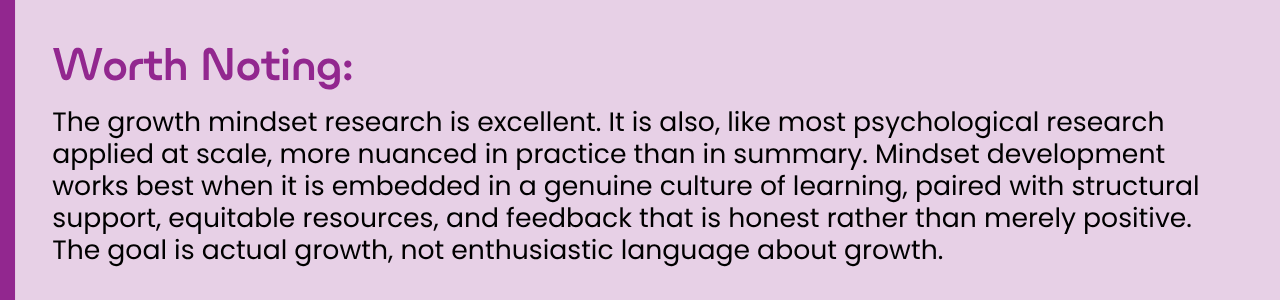
The research, synthesized across classroom and workplace contexts, consistently points to the same practices. Here are some Pathful resources and practices that hold up:
- Name it explicitly. Growth mindset does not develop through osmosis. Students and employees benefit from understanding the concept, the research behind it, and why it matters. Don't assume people will absorb it by being in proximity to it. Pathful's lessons Understanding Growth Mindset and Growth Mindset in the Workplace give students a structured foundation, while short employability videos like "What Is Growth Mindset" and "Fixed vs. Growth Mindset" work well as a hook to open a classroom conversation or a quick wrap-up to close one.
- Praise process, not just outcome. Recognize effort and strategy in conjunction with learning — not as substitutes for it. "You tried a new approach and it led to improvement" is better than "great effort!" which, as Dweck noted, can feel hollow when accompanied by ongoing failure. The video “Growth Mindset Indications" and the lesson Having a Growth Mindset Allows You to Grow reinforce this distinction in student-accessible language.
- Make feedback a two-way norm. Environments where feedback only flows downward — from teacher to student, manager to employee — are not growth mindset environments. They are compliance environments in nice clothes. Pathful's lesson Embracing Constructive Criticism and videos “Learning How to Receive Constructive Criticism Helps You Advance", “Use Criticism to Your Advantage”, and “How Criticism Can Be Constructive” give students both the framework and the language for making feedback a productive experience rather than a verdict.
- Add the word yet. "I can't do this" becomes "I can't do this yet." This is a small linguistic intervention with a disproportionate effect on framing. It's also completely free, which is a good feature in an educational strategy.
- Let the struggle happen. The impulse to rescue someone from difficulty — in a classroom or a workplace — is understandable and often counterproductive. Productive struggle is where skill development actually occurs. Jumping in prematurely takes that away. The lesson “Failure Is Success in Progress” pairs well here, reframing setbacks as data rather than verdicts.
- Model it authentically. Teachers and leaders who share their own mistakes, acknowledge their own learning edges, and demonstrate recovery from failure give others permission to be imperfect and improve. Leaders who project infallibility create cultures where everyone is quietly terrified of being the one who doesn't have it figured out. Consider opening a unit on growth mindset by sharing a genuine professional stumble — then showing how you used it.
The Short Version, For Those Who Skipped to the End
Carol Dweck spent decades studying why some people grow when they encounter difficulty and others don’t. The answer, supported by a substantial body of rigorous research, is that it comes down to what they believe about their own ability to learn. A growth mindset — the belief that intelligence and skill can be developed — predicts better academic outcomes, stronger professional performance, more adaptive organizations, and considerably more interesting careers.
The fixed mindset, in contrast, is a story about limits. And stories, importantly, can be revised.
The growth mindset isn’t a personality trait you either have or lack. It’s a cognitive habit that can be built through deliberate practice, honest feedback, and the occasional willingness to look bad at something before you get good at it. Which, as it happens, is exactly the posture the modern workplace requires of everyone — students, teachers, managers, and the occasional executive who has gone somewhat too long without receiving meaningful feedback.
The brain you have today is not the brain you're stuck with. There is an entire body of peer-reviewed literature to back that up — and now you've read some of it.
Sources & Further Reading
For the research-inclined, the following sources were used in developing this article:
Primary Sources
Dweck, C. S. (2006). Mindset: The New Psychology of Success. Random House.
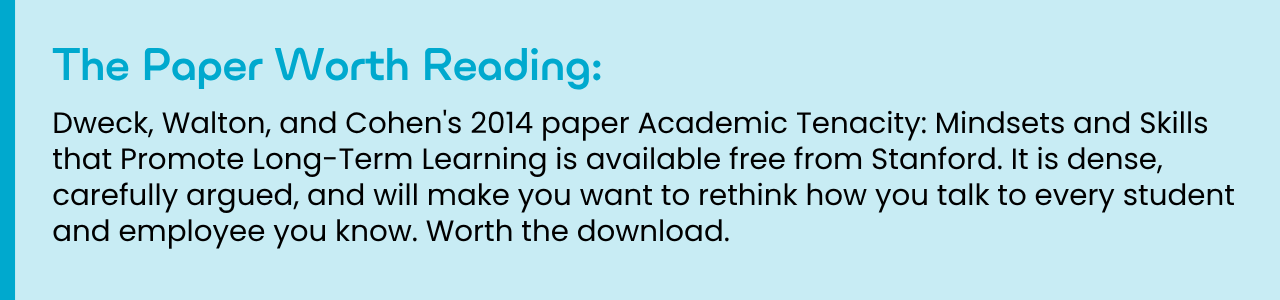
Dweck, C. S., Walton, G. M., & Cohen, G. L. (2014). Academic Tenacity: Mindsets and Skills that Promote Long-Term Learning. Bill & Melinda Gates Foundation / Stanford University. https://ed.stanford.edu/sites/default/files/manual/dweck-walton-cohen-2014.pdf
Dweck, C. S. (2015). Carol Dweck Revisits the ‘Growth Mindset.’ Education Week. https://www.edweek.org/leadership/opinion-carol-dweck-revisits-the-growth-mindset/2015/09
Dweck, C. S. (2016). What Having a ‘Growth Mindset’ Actually Means. Harvard Business Review. https://hbr.org/2016/01/what-having-a-growth-mindset-actually-means
Additional Sources
Stanford Teaching Commons — Growth Mindset and Enhanced Learning: https://teachingcommons.stanford.edu/teaching-guides/foundations-course-design/learning-activities/growth-mindset-and-enhanced-learning
Stanford Center for Teaching and Learning — Growth Mindset: https://ctl.stanford.edu/students/growth-mindset
Harvard Business School Online — Growth Mindset vs. Fixed Mindset: https://online.hbs.edu/blog/post/growth-mindset-vs-fixed-mindset
McCracken Alliance — Why a Growth Mindset Is Crucial for Business Leadership: https://www.mccrackenalliance.com/blog/why-a-growth-mindset-is-crucial-for-business-leadership
Human Performance IE — Fixed and Growth Mindset in the Workplace: https://humanperformance.ie/fixed-and-growth-mindset/
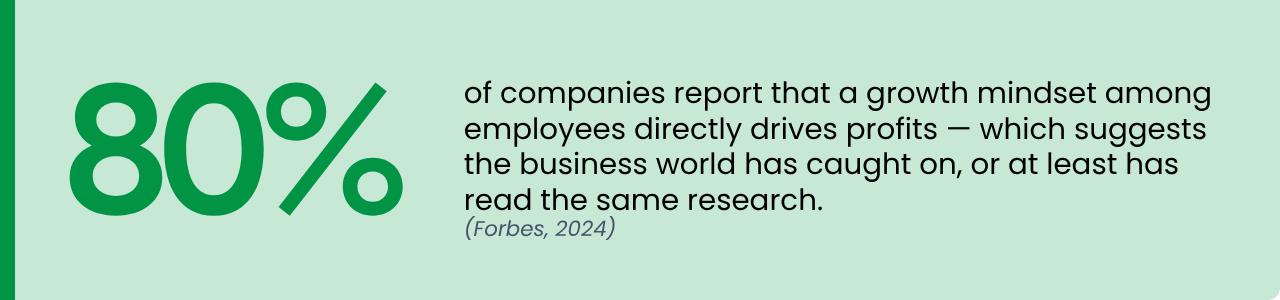
Forbes — 80% of Companies Say a Growth Mindset Among Employees Directly Drives Profits (Robinson, 2024): https://www.forbes.com/sites/bryanrobinson/2024/10/27/80-of-companies-say-a-growth-mindset-among-employees-directly-drives-profits/
BBC Worklife — The Growth Mindset All Workers Need to Cultivate: https://www.bbc.com/worklife/article/20221026-the-growth-mindset-all-workers-need-to-cultivate

.png)
.png)

.png)

.webp)





.png)
.png)

.png)

.png)
.png)




.png)

.png)



.png)



.png)


.png)


.png)
.webp)


.png)
.png)

.png)
.png)
%20(1).png)
.png)
.png)



.png)



.png)



.png)

.png)


.png)

.png)




.png)



.png)

.png)






.png)
.png)



.webp)
.webp)
%20(1)%20(1).webp)
.webp)
.webp)