
Bridging the Classroom and the Workplace: How Industry-Led Projects Deliver Authentic Work-Based Learning
Bridge the gap between classroom theory and career success. Discover how Pathful’s industry-led projects provide authentic, scalable work-based learning for students.
.png)
Work-based learning (WBL) has become a cornerstone of career readiness education. But for many educators, implementing meaningful WBL experiences feels like an uphill battle — limited employer partnerships, scheduling conflicts, transportation barriers, and liability concerns can make traditional workplace placements feel out of reach.
What if there was a way to bring authentic industry experiences into any classroom, without leaving the building?
Enter Industry-Led Projects (ILPs) — problem-based learning experiences designed with industry professionals that give students hands-on practice solving real workplace challenges. In this post, we'll explore how ILPs align with the established work-based learning continuum and why they're becoming an essential tool for scaling career preparation.
Understanding the Work-Based Learning Continuum
Before diving into ILPs, it's important to understand how work-based learning is structured. Most state frameworks organize WBL along a developmental continuum with four stages:
.png)
The key insight? Students benefit most when WBL activities are sequenced progressively over time — moving from awareness through exploration, preparation, and eventually training. Jumping straight to an internship without foundational experiences often leads to mismatched placements and disengaged students.
Where Industry-Led Projects Fit on the Continuum
Industry-Led Projects sit squarely in the Career Preparation stage — the critical bridge between exploring careers and training for them.
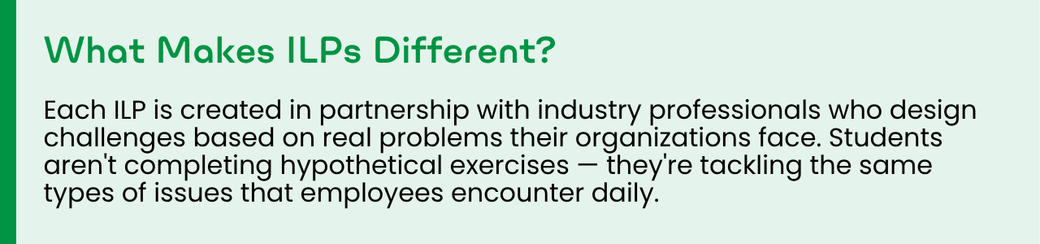
ILPs require students to actively apply skills to solve authentic industry problems. They're doing the work — researching, ideating, collaborating, and presenting — just as they would in a real workplace.
ILP in Action: Junior Architect — Homes for Heroes
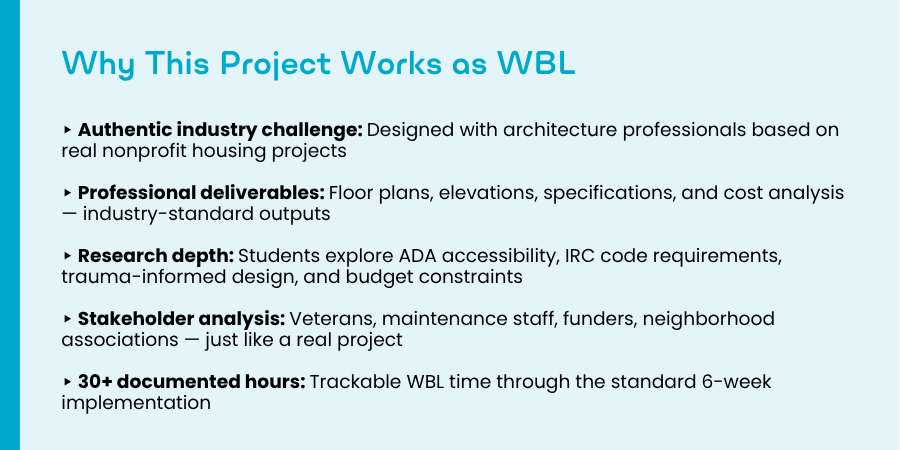
What does a real Industry-Led Project look like? Consider "Junior Architect: Homes for Heroes" — a project where students become junior architects at a fictitious firm, designing tiny home prototypes for a nonprofit providing transitional housing for veterans experiencing homelessness.
This isn't a worksheet about architecture. Students research accessibility standards, trauma-informed design principles, and tiny home best practices. They create scaled floor plans, site plans arranging 12-16 homes on a real parcel, exterior elevations, detailed kitchen and bathroom layouts, design narratives, specifications, and cost analyses — exactly what a real architectural firm would deliver.
Mapping ILP Phases to WBL Components
High-quality work-based learning programs share three essential components identified in federal legislation and research. Here's how each ILP phase addresses them:
.png)
Why ILPs Work for Scaling WBL
Traditional work-based learning faces real barriers — employer capacity, transportation, scheduling, liability, and geographic limitations. ILPs address these challenges head-on:
▸ Scalability: Every student can participate, not just those with employer connections or transportation access
▸ Equity: Rural and under-resourced schools gain access to the same quality industry experiences as suburban districts
▸ Documented Hours: Each project provides 20-30 hours of trackable WBL experience for accountability reporting
▸ Classroom Integration: Teachers maintain instructional control while delivering authentic industry content
▸ Pathway Preparation: Students build foundational skills before moving to intensive internships or apprenticeships
"In a CTE position, I need dynamic and flexible options, and Pathful has checked all my boxes. Learners really love these assignments — it gives them meaningful context for their careers and things to think about, while saving me hours."
— Summer Highfill, CTE Educator, Oregon
Getting Started with Industry-Led Projects
Ready to bring authentic work-based learning into your classroom? Here's how to begin:
1. Assess your current WBL landscape — Where are the gaps? Which students lack access to preparation-level experiences?
2. Identify alignment opportunities — Which courses or career pathways would benefit most from project-based industry challenges?
3. Plan your timeline — ILPs typically span 3-6 weeks. Build them into your semester calendar with clear milestones.
4. Request industry sessions early — Connecting students with professionals enhances the experience. Schedule these before the project begins.
5. Track and document — Use your WBL tracking system to log student hours for accountability reporting.
The Bottom Line
Work-based learning doesn't have to mean leaving the building. Industry-Led Projects bring the workplace into the classroom, giving every student the chance to tackle real challenges, develop essential skills, and build confidence for their future careers.
By positioning ILPs within the Career Preparation stage of the WBL continuum, educators can create a structured pathway that moves students from awareness through exploration, preparation, and — when ready — into immersive career training experiences like internships and apprenticeships.
The future of work demands career-ready graduates. ILPs help you get them there.
Ready to Explore Industry-Led Projects?
See how Pathful can help you scale authentic work-based learning for every student.
Learn More or View Industry-Led Projects in Pathful

.png)
.png)

.png)

.webp)





.png)
.png)

.png)

.png)
.png)




.png)

.png)



.png)

.png)


.png)


.png)
.webp)

.png)
.png)

.png)
.png)
%20(1).png)
.png)
.png)


.png)



.png)



.png)

.png)

.png)

.png)




.png)



.png)

.png)





.png)
.png)



.webp)
.webp)
%20(1)%20(1).webp)
.webp)
.webp)